

.png)

A Definitive Water Filtration Systems Comparison for LA Homes
Worried about the taste of your tap water or what contaminants might be lurking in it? You're not alone. The first big question is always the same: do you treat the water for your entire home, or just at a specific tap? This is the core difference between whole-house systems and point-of-use (POU) systems, and it's the decision that shapes everything else—from cost and upkeep to exactly what gets filtered out of your water here in Los Angeles.
Why Comparing Water Filtration Systems Matters
Choosing a water filter is about more than just improving taste; it's an investment in your family's health and the longevity of your home’s plumbing. With growing concerns over contaminants like chlorine, heavy metals, and other chemicals in urban water supplies, understanding your options is more critical than ever. The right system provides confidence every time you fill a glass, wash vegetables, or take a shower.
The market is responding to these concerns. The home water filtration industry was valued at USD 20.26 billion in 2024 and is projected to reach USD 50.89 billion by 2033. This isn't surprising, considering over 60% of U.S. households already use some form of point-of-use filter. You can explore the full market research on home water filtration trends to see how this demand is driving technological advancements.
Key Factors in Your Decision
Before diving into a detailed water filtration systems comparison, it's helpful to understand the main categories. Each type is designed for a different purpose, and what works for a small apartment won't be sufficient for a large family home. The table below offers a simple, at-a-glance breakdown to clarify the landscape. Think of it as a starting point that frames all the other decisions to come. For a more detailed look at the advantages, you can read our guide on the benefits of a home water filtration system.
Quick Comparison of Water Filtration System Types
This high-level summary gives you a quick feel for where each system fits. It's the perfect way to orient yourself before we dig into the specifics of what each one can do for your home.
System Type | Primary Function | Best For | Typical Cost Range |
|---|---|---|---|
Whole-House | Treats all water at the point of entry | Homeowners wanting comprehensive protection for plumbing and appliances | $1,000 - $4,000+ |
Under-Sink | Filters water at a specific tap (e.g., kitchen) | Renters or homeowners wanting high-purity drinking water | $250 - $1,500 |
Countertop | Sits on the counter and connects to the faucet | Easy, portable filtration for renters or small spaces | $100 - $300 |
Faucet-Mounted | Attaches directly to a standard faucet | A simple, low-cost solution for basic taste and odor improvement | $30 - $100 |
As you can see, the options range from comprehensive solutions to targeted, simple fixes. Now, let's explore what makes each of these systems tick.
Whole-House vs. Point-of-Use: A Foundational Choice
When you start digging into any water filtration systems comparison, the first choice you'll face is also the biggest: do you filter the water for your entire house, or just for a specific tap? This isn’t a minor detail. It’s the decision that shapes your whole approach to water quality, influencing everything from cost and upkeep to the health of your home's plumbing.
You're basically choosing between comprehensive protection and targeted purity. A whole-house water filtration system, also known as a Point-of-Entry (POE) system, is installed where the main water line enters your home. That means every single drop—from your shower to your washing machine and, of course, your kitchen sink—gets treated.
On the flip side, a point-of-use (POU) system is installed at a single location, like under your kitchen sink or on the countertop. It’s designed to deliver highly purified water exactly where you’ll be drinking and cooking with it, making it a fantastic option if you just want to improve taste and safety without treating the water you use for laundry or flushing toilets.
Whole-House Systems: Comprehensive Home Protection
For homeowners in Los Angeles, a whole-house system is more than a filter; it's an investment in the property itself. By treating all incoming water, it does more than just improve your drinking water. It stands guard over your entire plumbing infrastructure and all your water-using appliances.
This all-in-one approach has some major perks:
Appliance Longevity: Hard water minerals and sediment are brutal on expensive appliances. They build up in your dishwasher, washing machine, and water heater, reducing their efficiency and shortening their lifespan. A whole-house system stops these culprits at the door.
Plumbing Protection: By filtering out corrosive elements like chloramine—a common additive in LA’s municipal water—you’re actively protecting your pipes from premature decay and costly leaks.
Healthier Showers: Your skin and hair absorb chemicals from shower water. Filtering this water reduces your exposure to chlorine and other irritants, which often leads to noticeably softer skin and healthier hair.
A key differentiator for whole-house systems is their role in asset protection. They aren't just about better-tasting water; they are a preventative measure that safeguards thousands of dollars in appliances and plumbing from the gradual damage caused by untreated water.
This is why whole-house filtration is a popular choice for homeowners who are thinking long-term about preserving their property's value and avoiding big repair bills down the road.
Point-of-Use Systems: Targeted Purity Where It Counts
While whole-house systems act as a broad shield, point-of-use (POU) systems are more like a sniper rifle. If your main goal is getting the absolute purest water for drinking and cooking, an under-sink system—like a reverse osmosis (RO) filter—is often the best tool for the job.
POU systems excel at removing a wider range of contaminants at a single tap than most whole-house setups can. Because they only treat a small amount of water, they can use more sophisticated, multi-stage filtration methods that aren’t practical or affordable for an entire home.
Consider these situations where a POU system really shines:
Renters and Apartment Dwellers: For anyone who can't alter their home's main plumbing, a POU filter is an effective, non-permanent way to get fantastic drinking water.
Budget-Conscious Homeowners: The upfront cost for a top-notch POU system is significantly lower than a whole-house installation. It gets you excellent drinking water without a huge initial investment.
Specific Health Concerns: If someone in your household has specific health issues, the incredible purification from an under-sink RO system delivers maximum peace of mind.
Ultimately, the right choice boils down to your priorities. Are you looking to protect your entire home's infrastructure, or do you want the absolute highest level of purity at your kitchen sink? Making this foundational choice sets the stage for every other decision in your journey toward cleaner, safer water.
A Detailed Comparison of Filtration Technologies
Deciding between a whole-house and a point-of-use system is your first big choice, but the real work happens inside the filter. Understanding the technology gives you the power to pick the right solution. Not all filters are created equal, and a close water filtration systems comparison reveals how differently they remove contaminants.
You'll mainly encounter three types of filtration: Reverse Osmosis (RO), Activated Carbon, and Ultraviolet (UV) Purification. Each one tackles water problems using a completely different method, so they're designed to go after very different kinds of contaminants. Let's dig into how they work and which one is the right tool for the job, especially for the water issues common in Los Angeles.
This chart gives you a quick visual on the difference between treating water for your entire home versus just one specific faucet.
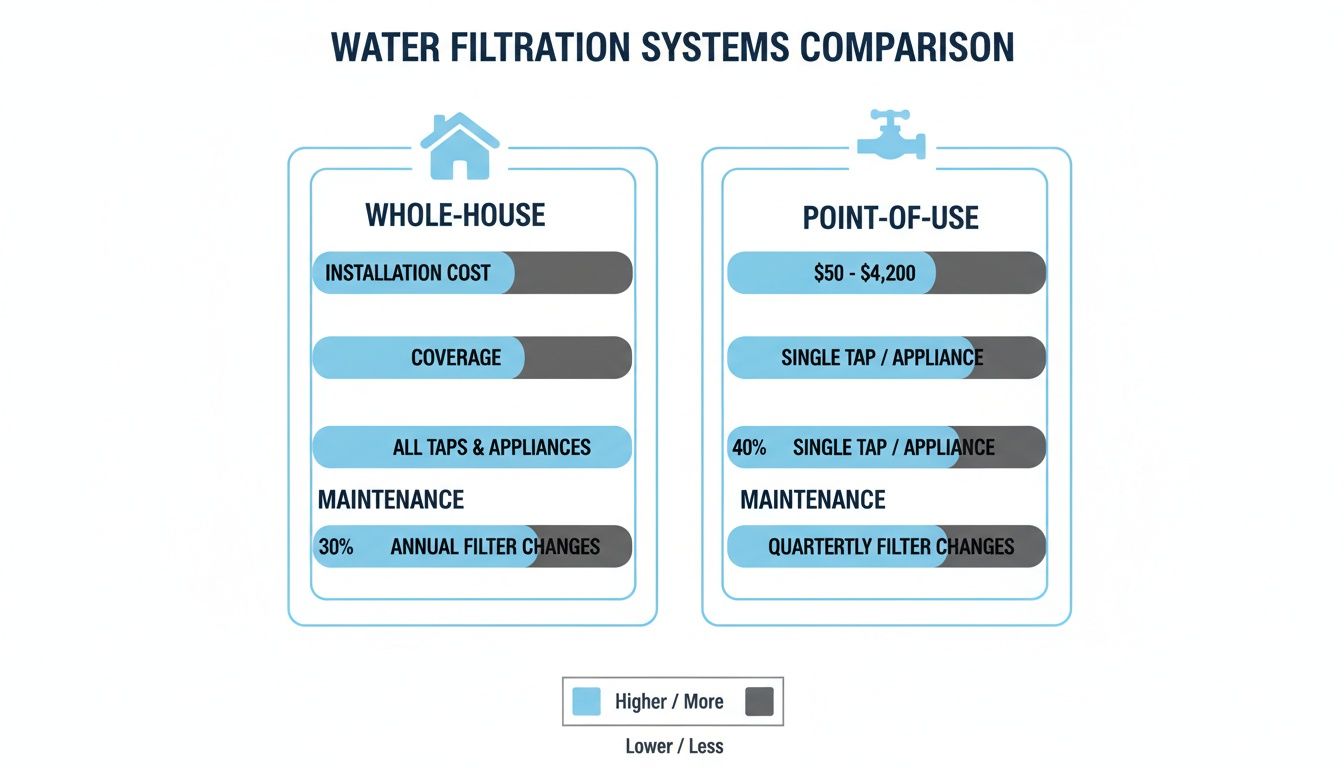
As you can see, whole-house systems cast a wide net, offering protection everywhere. Point-of-use systems, on the other hand, deliver highly targeted, powerful purification exactly where you need it most.
Reverse Osmosis: The Purity Powerhouse
Reverse Osmosis (RO) is widely considered the gold standard in water purification. It works by forcing water through a semi-permeable membrane with microscopic pores—so tiny that almost nothing but pure water molecules can pass through. This makes it incredibly effective at removing a huge list of contaminants.
Here’s what RO is great at getting rid of:
Dissolved Solids: This covers everything from salts and minerals to heavy metals like lead, arsenic, and mercury.
Chemicals: It’s highly effective against fluoride and even some pharmaceuticals that can end up in the water supply.
Microorganisms: The RO membrane is fine enough to block bacteria, viruses, and cysts.
RO is so effective that it captured a 29% market share in 2024. This is because it can remove up to 99% of dissolved solids, bacteria, and viruses, making it a perfect fit for urban water that often carries a mix of contaminants. In fact, homeowners with RO systems report 75% fewer plumbing-related water quality issues, and the reduction in scale buildup can even extend the life of their pipes by 20-30%.
This level of filtration does have a couple of trade-offs. The process is slow, which is why most RO systems have a small storage tank. It also produces some wastewater (called brine) that gets flushed away. Even so, if you want the absolute purest water for drinking and cooking, an under-sink RO system is tough to beat.
Activated Carbon: The Contaminant Magnet
Activated carbon is one of the most common and trusted technologies available, found in everything from simple pitcher filters to heavy-duty whole-house systems. It works through a process called adsorption, where contaminants stick to the surface of the carbon as water passes by.
Think of activated carbon as a sponge with a massive, porous surface area. This structure is what makes it so good at grabbing certain contaminants and holding on tight.
The biggest win for activated carbon is how it improves taste and odor. It excels at removing chlorine and chloramine, the disinfectants used in city water that give it that "swimming pool" smell and taste.
Activated carbon filters are also fantastic at removing:
Organic Chemicals: This includes things like pesticides, herbicides, and volatile organic compounds (VOCs).
Disinfection Byproducts: It targets substances like trihalomethanes (THMs), which can form when chlorine mixes with organic matter.
Sediment: Depending on the filter, it can also trap larger particles like rust, sand, and silt.
While it’s great for improving aesthetics and removing chemicals, a standard carbon filter won’t remove dissolved solids, heavy metals, or microorganisms. That's why many people look into multi-stage systems that combine different technologies for more complete protection. You can get a better sense of what might work for you by looking over our guide on choosing the perfect water filtration system.
UV Purification: The Microbiological Guardian
Ultraviolet (UV) purification is a completely different approach—it doesn't actually remove anything from the water. Instead, it uses a powerful UV-C light to neutralize living microorganisms, rendering them harmless. As water flows past the UV lamp, the light scrambles the DNA of bacteria, viruses, and cysts so they can't reproduce and cause illness.
UV purifiers are often the last line of defense in a multi-stage system, like a microbiological safety net. They're especially useful for homes on well water or in areas that sometimes get boil water advisories.
A few key benefits of UV purification:
Chemical-Free Disinfection: It offers powerful protection without adding any chemicals to your water.
Highly Effective: A properly sized UV system can neutralize over 99.99% of harmful microorganisms.
Low Maintenance: The main task is simply replacing the UV lamp once a year.
It’s crucial to remember that UV is a specialist. It does nothing for sediment, chemicals, heavy metals, or dissolved solids. Because of this, it’s almost always paired with a pre-filter (like a sediment or carbon filter) to ensure the water is clear. If the water is cloudy, tiny particles can shield microbes from the UV light, reducing the system's effectiveness.
To make sense of these technical details, it helps to see them side-by-side. This table breaks down what each technology does best.
Technical Specs: Water Filtration Technology Showdown
Filtration Technology | Key Contaminants Removed | Typical Micron Rating | NSF/ANSI Certification | Impact on Flow Rate |
|---|---|---|---|---|
Reverse Osmosis | Dissolved solids (lead, arsenic, salt), fluoride, bacteria, viruses, cysts | 0.0001 microns | NSF/ANSI 58 | Can significantly reduce flow; often requires a storage tank |
Activated Carbon | Chlorine, chloramine, pesticides, VOCs, THMs, improves taste/odor | 0.5 to 50 microns | NSF/ANSI 42, 53 | Minimal to moderate impact, depends on filter density |
UV Purifiers | Bacteria, viruses, protozoa (Giardia, Cryptosporidium) | N/A (disinfection) | NSF/ANSI 55 | Minimal impact, as long as water is clear |
This breakdown highlights the strengths and weaknesses of each system. An RO system offers unparalleled purity but affects flow rate, while an activated carbon filter is the go-to for better taste and odor with less impact on pressure. UV is your specialist for microbiological safety, but it needs a partner to handle other contaminants.
Understanding the True Cost of Clean Water
When you start comparing water filtration systems, the initial price tag is just the beginning. The real story is the total cost of ownership—what you’ll actually spend over the system's entire life. Looking past the upfront sticker price is the only way to budget properly and avoid surprises down the road.
To truly understand the investment, you need to break it down into three key areas: initial purchase and installation, recurring maintenance, and long-term operational costs.
Initial Purchase and Professional Installation
Your first expense is the system itself, plus the cost to have it professionally installed. This is where you’ll see the biggest price differences. A simple under-sink carbon filter might only set you back a few hundred dollars, installed. On the other hand, a high-capacity, whole-house reverse osmosis system can easily run into the thousands.
In a place like Los Angeles, professional installation is a non-negotiable part of the investment. It guarantees your system runs at peak efficiency, meets local plumbing codes, and keeps your manufacturer's warranty valid. Trying to DIY a complex system can lead to leaks, pressure problems, and expensive water damage, wiping out any money you thought you were saving.
Think of professional installation as insurance for your investment. A system that’s set up correctly from day one will last longer, work better, and save you from the costly headaches that come from a botched job.
Ongoing Maintenance and Filter Replacements
The next major cost is maintenance, which primarily means replacing filters on schedule. How often you have to do this, and how much it costs each time, are huge factors in your decision.
Here’s a rough idea of what to expect from different systems:
Whole-House Sediment Filters: These are usually your first line of defense. They need to be replaced every 3-6 months and typically cost around $25-$75 per filter.
Activated Carbon Filters: Whether for a whole-house unit or under the sink, these filters usually last 6-12 months. Replacements will run you anywhere from $50 to $150.
Reverse Osmosis Membranes: This is the heart of an RO system. The good news is it has a long lifespan of 2-4 years. The bad news is it's pricier to replace, often costing $100-$300.
These costs add up, so it's essential to factor them into your budget. A system that seems like a bargain upfront could end up being more expensive if its filters are pricey and need frequent changes.
Long-Term Operational Costs
The final piece of the financial puzzle is the day-to-day cost of running the system. While many systems are passive, some have ongoing expenses built into their technology.
A Reverse Osmosis system, for example, creates wastewater (brine) as part of its process. Modern, high-efficiency models are much better about this, but you can still expect a slight increase in your water bill. Likewise, a UV purification system needs electricity to power its lamp, adding a small but steady amount to your energy costs. That UV lamp also needs to be replaced annually, which is another maintenance expense to keep in mind.
The growing demand for these advanced systems is part of a much bigger picture. The global water filtration market hit about USD 14.23 billion in 2024 and is expected to rocket to USD 35.59 billion by 2034. This boom is driven by health concerns and the struggle to deal with contaminants in areas with aging infrastructure, just like we have here in Greater Los Angeles. You can read more about the global market trends for water filtration to see just how big this shift is.
We know these big investments can feel overwhelming, which is why we offer flexible payment plans to make them more manageable. You can learn more about our homeowner customer financing options and find a solution that works for your budget without cutting corners on water quality. By looking at all three cost areas, you can make a smart, informed decision that will bring clean, safe water to your family for years to come.
Making the Right Choice for Your LA Property
A good water filtration systems comparison is less about technical specs and more about you. The "best" system isn't the one with the fanciest features—it's the one that fits your life, your home, and your biggest concerns. Los Angeles isn't a one-size-fits-all city, and your water needs will look completely different depending on your neighborhood and lifestyle.
Let's cut through the noise and connect real-world LA scenarios to the right filtration solutions. By looking at a few common situations, you can quickly spot which one sounds like you and choose with confidence.
For the Family in Glendale Concerned About Purity
If you have young kids at home, your top priority is likely the purity of your drinking and cooking water. You’re thinking about the things you can't see, like lead from older pipes or the byproducts of chlorine, and how they might affect your family's health.
Ideal Solution: An under-sink Reverse Osmosis (RO) system in the kitchen.
This is a targeted, powerful approach. An RO system is the gold standard for removing the widest possible range of contaminants, from heavy metals to dissolved solids. It puts the highest level of purification right where you need it most—the kitchen tap—without the cost and complexity of a whole-house RO installation. It’s peace of mind in a glass.
Your home is a major investment, and water quality is a big part of protecting it. For anyone in the market, this expert guide to buying property in Los Angeles offers great insights into evaluating home systems during the buying process.
This solution is practical, cost-effective, and directly addresses the most critical health concerns for a growing family.
For the Property Manager in Santa Monica Battling Hard Water
As a property manager, you're juggling two things: keeping tenants happy and protecting the owner's investment. In coastal spots like Santa Monica, hard water is the enemy. It creates scale buildup that destroys expensive appliances like water heaters, dishwashers, and washing machines, and the constant repair calls eat into your profits.
Ideal Solution: A whole-house carbon filter paired with a water softener.
This dual-threat system is a smart business move. The carbon filter removes chlorine and chloramine, which improves the water's taste and protects pipes from corrosion. Then, the water softener gets to work on the minerals that cause that destructive scale. You'll extend the life of your plumbing and appliances, reduce maintenance calls, and keep your tenants happy.
For the Renter in a Hollywood Apartment
When you're renting, you need something that works without making permanent changes. You can't exactly re-plumb the apartment, but you still want water that tastes better and is free of common contaminants. Your solution has to be effective, affordable, and easy to take with you when you move.
Ideal Solution: A high-quality countertop or faucet-mounted filter.
These point-of-use systems are perfect for renters. They use activated carbon to dramatically reduce chlorine, lead, and other things that make tap water taste off. There's no plumber needed for installation, giving you an excellent balance of performance and convenience for apartment life.
Integrating Filtration with Total Home Safety
A whole-house filtration system is a fantastic line of defense, protecting your health and your plumbing from the inside. But what about bigger threats, like a catastrophic leak? For total protection, you need to think about both water quality and water damage.
Pairing a whole-house filter with an automatic water shut-off valve creates a comprehensive safety net. While the filter protects your pipes from corrosive elements, the shut-off valve protects your home by instantly stopping the flow if a leak is detected. It's an integrated approach that guards against contamination and property damage—a truly smart move for any homeowner. While you're making these upgrades, you might also want to explore eco-friendly plumbing upgrades for Pasadena homeowners to boost both safety and efficiency.
Your Water Filtration Questions Answered
Choosing a water filtration system is a big decision, and it’s natural to have questions. To ensure you feel completely confident in your choice, we’ve answered some of the most common questions we hear from Los Angeles homeowners.
How Often Do I Need to Replace Water Filters?
The replacement frequency depends entirely on the type of system you have and your local water quality. There’s no single timeline that fits every home.
Under-sink carbon filters: Typically need replacement every 6 to 12 months.
Reverse osmosis membranes: Can last 2 to 3 years.
Whole-house sediment filters: May need to be swapped every 3 to 6 months, depending on the amount of sediment in your water.
Following the manufacturer’s schedule isn’t just a suggestion—it's critical. An old, clogged filter doesn't just stop filtering; it can become a breeding ground for bacteria and release trapped contaminants back into your water.
Will a Filtration System Lower My Water Pressure?
A correctly sized and professionally installed system should have a minimal, often unnoticeable, effect on your water pressure. If you do see a significant drop, it’s usually a sign that something is wrong.
The most common culprit is a clogged filter that's due for replacement. However, an undersized system can also create a bottleneck that restricts water flow. This is why a professional assessment is crucial to match your home's demand with a system that has the right flow rate, measured in gallons per minute (GPM).
Can I Install a Water Filtration System Myself?
While simple faucet-mounted or countertop filters are designed for DIY installation, more complex systems should be handled by a professional. Whole-house filters and under-sink reverse osmosis units must be tied directly into your plumbing lines.
A small installation mistake can lead to major leaks, water damage, and will almost certainly void the manufacturer’s warranty. A licensed plumber ensures the job is done right, meets local codes, and will work reliably for years to come.
What Is the Difference Between Water Filtration and Water Softening?
This is a key distinction, as these two systems solve completely different problems.
Water filtration is about purity. It removes contaminants like chlorine, lead, pesticides, and bacteria to make your water safer and taste better.
Water softening is about mineral content. It specifically removes calcium and magnesium—the minerals that cause "hard water." While not a health risk, these minerals create limescale buildup that can damage your pipes, water heater, and appliances.
For many homes in Los Angeles, the best solution is a combination of both: a water softener to protect the plumbing and a filtration system to purify the water you use every day.
We hope this water filtration systems comparison has given you the clarity to find the perfect solution for your home. If you still have questions or you’re ready to get started, our team is here to help.
The experts at ZH Plumbing can test your water and provide a personalized recommendation that fits your needs and budget. Contact us today to schedule your free inspection.
Comments