

.png)

Los Angeles Guide to Troubleshooting Gas Water Heaters: Safe, Practical Fixes
Stepping into a shower and getting hit with a blast of icy water is one of the worst ways to start your day, especially when you're in a rush. If you're a Los Angeles homeowner, your mind might jump to an expensive emergency plumbing call. But before you panic, many common gas water heater problems have surprisingly simple fixes you can often handle yourself in just a few minutes.
Your First Steps When the Hot Water Vanishes
Before assuming the worst, a quick diagnostic can save you time and money. The problem is often something as straightforward as a pilot light that’s gone out or a thermostat dial that got bumped. By methodically checking the most common culprits, you can often get your hot water running again without a service call from a plumber in Los Angeles.
The goal here is to rule out the easy stuff first. We'll focus on the three core components of your gas water heater: the pilot light, the gas supply, and the thermostat. If any one of these isn't working right, your heater won't be able to do its job.
Check the Pilot Light and Gas Supply
The pilot light is a tiny, continuous flame that ignites the main burner whenever the tank needs to heat more water. If that flame goes out, your heater is effectively off. Take a look near the bottom of the tank; there should be a small access panel or window where you can see if the pilot is lit.
While you're down there, double-check the gas valve. This is usually a small handle on the gas line running into the water heater. To be open, the handle should be parallel with the pipe. It's surprisingly common for this valve to get knocked into the "off" position by accident, especially in busy garages or utility closets in homes across the San Fernando Valley.
A pilot light that repeatedly goes out is more than just an annoyance—it's a red flag. This is one of the most common reasons homeowners in areas like Pasadena and Glendale call us, and it often points to a failing thermocouple or a dirty pilot assembly that needs professional attention.
Verify the Thermostat Setting
This one seems obvious, but you’d be surprised how often it’s the solution. Check the thermostat dial on the gas control valve. It might have been accidentally turned down to a "Low" or "Vacation" setting, which keeps the pilot on but prevents the main burner from firing.
Make sure the dial is set to a reasonable temperature, typically between 120°F and 140°F. Anything higher poses a scalding risk and is a waste of energy. If the setting is correct but you still have no hot water, the thermostat itself could be the issue.
This flowchart is a great visual guide for walking through these initial steps.
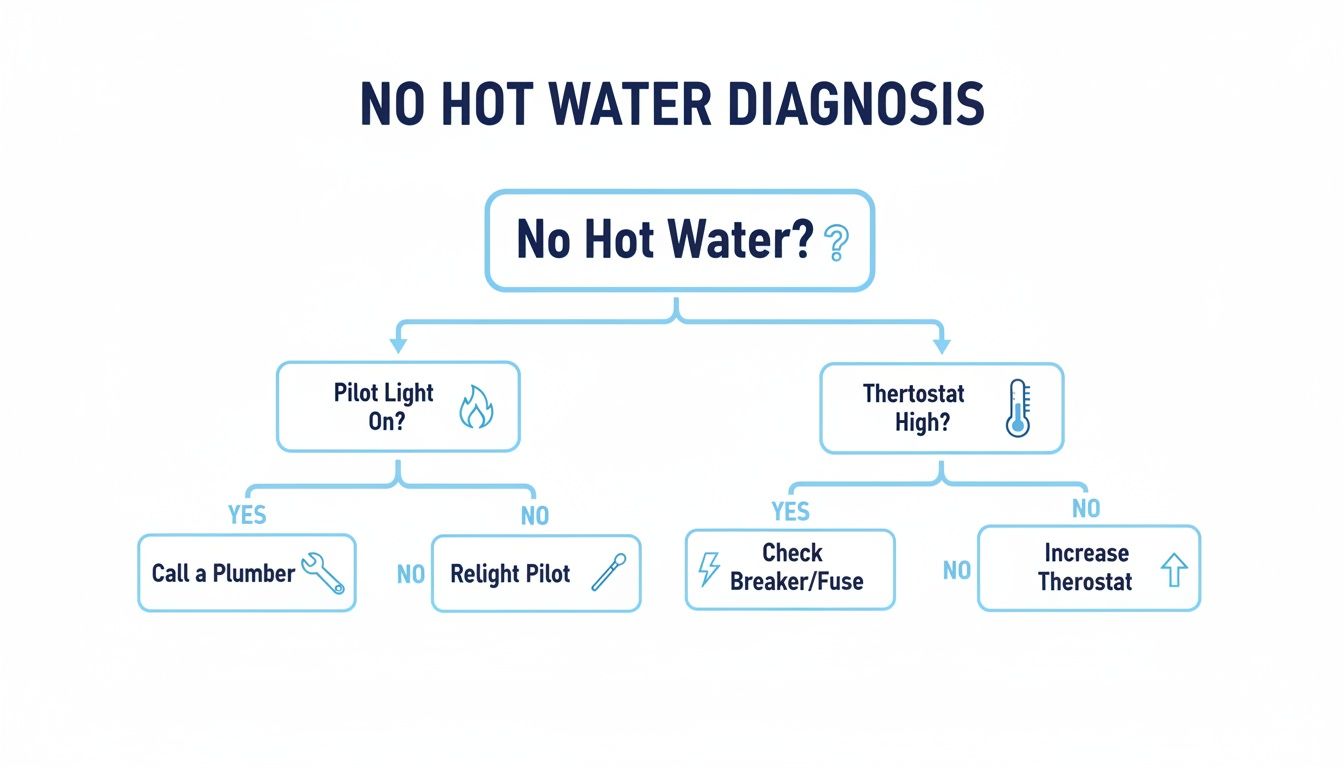
Sometimes, seeing the diagnostic path laid out makes the process feel much less intimidating. It guides you from the simplest checks, like the pilot light, to slightly more involved ones.
To give you some perspective, industry data shows that around 30% of all gas water heater service calls are related to the pilot light, the gas valve, or a blocked vent. These components are absolutely critical for safe operation, which is why we always start our diagnosis there.
For Los Angeles homeowners, another common issue is sediment buildup, thanks to our hard water. Regular maintenance can prevent a lot of headaches. To learn how to do it yourself, check out our guide on water heater flushing for Los Angeles homes.
Decoding Strange Noises and Smells
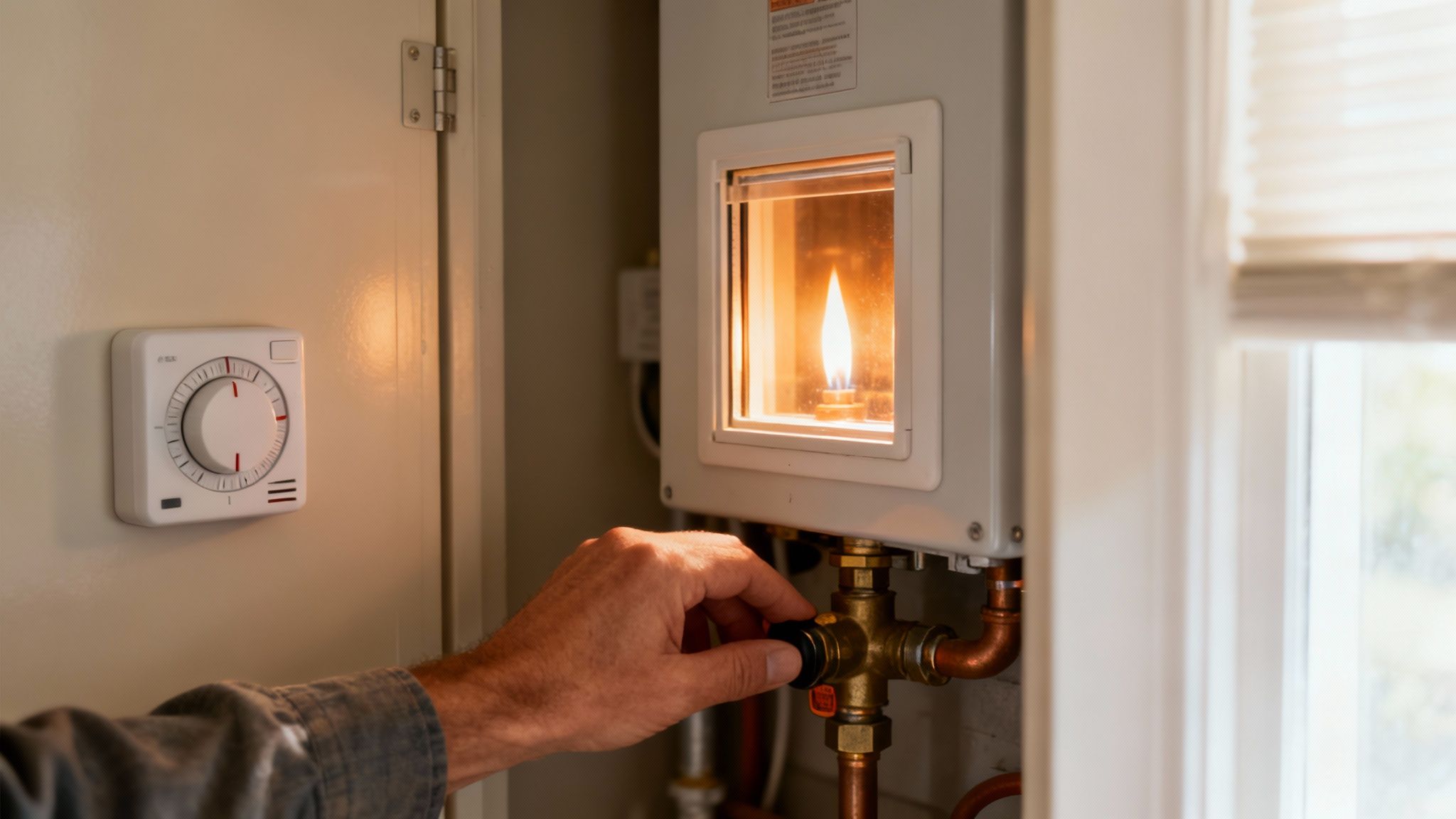
Your water heater will never be completely silent, but it definitely shouldn't sound like a science experiment gone wrong. If you're hearing odd noises or noticing strange smells, that's your unit's way of telling you something needs a closer look. Ignoring these signals is a recipe for bigger problems, higher gas bills, and even serious safety risks.
Learning to translate these sounds and smells is a huge part of troubleshooting a gas water heater. Some are just minor annoyances, but others are urgent warnings. One particular smell, in fact, signals an immediate emergency that every single Los Angeles homeowner needs to recognize on the spot.
Understanding Popping and Rumbling Noises
The number one noise complaint we get from homeowners in Glendale and Pasadena is a loud popping, cracking, or rumbling from the tank. No, it's not a ghost in the machine. It's almost always a classic sign of sediment buildup. Southern California has notoriously hard water, packed with minerals like calcium and magnesium.
Over time, these minerals drop out of the water and form a thick, crusty layer of scale on the bottom of the tank. When the burner kicks on, it has to heat the water through this layer of rock. Pockets of water get trapped underneath, flash-boil into steam, and create those popping and banging noises as they violently escape.
This isn't just loud; it's incredibly inefficient. That sediment layer acts like insulation, forcing your heater to burn more gas and run much longer to get your water hot. That kind of strain will absolutely shorten the life of your appliance.
The reality for local homeowners is that hard water mineral deposits are a major factor in water heater issues. In fact, sediment-related problems are a leading cause of service calls across the Greater Los Angeles area, directly contributing to reduced performance and premature tank failure.
What Different Sounds Might Mean
Not every weird noise points to sediment. If you listen closely, the specific sound can give you clues before you even touch the unit.
Popping or Rumbling: The classic sign of sediment buildup. The only real fix here is to have a professional flush the tank.
Hissing or Sizzling: This could be a small water leak dripping onto the hot burner assembly below. It might also just be normal condensation, but if it’s constant, you need to check carefully for any signs of moisture.
Screeching or Whining: A high-pitched squeal often means there's a partially closed valve somewhere restricting water flow. Start by checking the main water inlet and outlet valves on the heater itself to make sure they're fully open.
Ticking or Clicking: A bit of this is normal as the metal parts expand and contract. But if it's unusually loud or happens constantly, it could indicate an issue with the gas control valve or the pilot light assembly.
The Most Critical Warning: A Rotten Egg Smell
While strange noises are usually maintenance issues, one particular smell is a drop-everything-and-act emergency: the distinct odor of rotten eggs or sulfur. Natural gas is odorless on its own, so utility companies add a chemical called mercaptan to give it that smell for your safety.
If you smell gas near your water heater or anywhere else in your home, you have a potential gas leak. This is the single most serious problem you can encounter when troubleshooting your gas water heater.
Here’s exactly what to do:
Do not touch any light switches, unplug anything, or use a phone inside the house. Even a tiny spark can be catastrophic.
Immediately put out any open flames, like candles or cigarettes.
Get everyone out of the property right away.
Once you are a safe distance away, call your gas company's emergency line first, then call a licensed plumber. Our emergency team at ZH Plumbing is trained for these exact situations, and you can learn more about our professional gas leak detection services.
Recognizing the source of these problems is crucial. Research indicates that hard water mineral deposits are a significant challenge, accounting for about 60% of water heater problems for service providers. In areas with mineral-rich water like Los Angeles, this buildup harms efficiency and causes other issues. Preventative maintenance is key, as its absence is linked to roughly 25% of all water heater malfunctions. You can explore more insights about common hot water system problems on mitchellplumbinggas.com.
How to Handle Leaks and Drips
Nothing sends a chill down a homeowner's spine quite like discovering a puddle of water around their gas water heater. Whether you're in Pasadena or Santa Monica, that moment of dread is universal. The key is not to panic. Instead, you need to act methodically to figure out where the water is coming from before a small problem becomes a full-blown flood.
Your first job is to play detective and find the source. Sometimes, the answer is simple and harmless, but other times it’s a critical warning that your tank is on its last legs. A careful, safe inspection is how you take back control.
Pinpointing the Source of the Water
Before you get too close, grab a good flashlight and start looking for any obvious drips or sprays. More often than not, the leak isn't coming from the big tank itself but from one of the pipes or valves connected to it.
Here are the usual suspects I check first on any service call:
Pipe Connections: Look right at the top of the heater where the cold water inlet and hot water outlet pipes are. These fittings can loosen or corrode over the years, causing slow drips that sneak down the side of the tank.
Temperature & Pressure (T&P) Relief Valve: This is a crucial safety valve, usually on the side or top of the tank, with a pipe running down toward the floor. It's designed to open if the pressure or temperature gets dangerously high. If water is dripping from this pipe, the valve might be faulty, or it could be signaling a serious pressure problem inside the tank.
Drain Valve: Down at the bottom, you'll find a valve that looks like a spigot. This is for flushing sediment out of the tank. If it wasn't closed tightly after the last flush or the washer inside is shot, it can be a prime spot for a slow leak.
If you’ve checked all these spots and still can't find the source, the situation might be more serious.
Condensation vs. a Real Leak
It's easy to mistake simple condensation for a real leak, especially during the cooler, damper months here in Los Angeles. When a large amount of cold water rushes into the tank to be heated, moisture can form on the outside surface—just like a cold glass of water on a summer day.
Pro Tip: Here’s a quick test. Wipe a damp spot on the tank completely dry with a paper towel. Watch it for a few minutes. If the moisture slowly reappears as a general dampness without a clear drip trail, it's probably just condensation. If a distinct water trail forms again quickly, you have an active leak on your hands.
This little diagnostic trick is vital. Condensation is completely harmless, but an active leak from the tank body is an emergency. Knowing the difference can save you from an unnecessary service call or, more importantly, alert you to a real problem. Hidden leaks can cause a world of trouble over time, so it pays to be vigilant. You can learn more by reading about the signs of a hidden water leak in your home.
Your Immediate Action Plan for a Serious Leak
If you see water pooling around the base of the heater and you've ruled out all the external pipes and valves, it’s a strong sign the inner tank has corroded through. This isn't something you can patch up; it means the water heater is done for and needs to be replaced right away.
When you suspect the tank itself has failed, you need to move fast to prevent a flood.
Shut Off the Water Supply: Find the cold water pipe going into your water heater. There will be a valve on it—often with a blue handle. Turn that valve clockwise all the way until it stops.
Shut Off the Gas: Look for the gas line that runs to the control unit at the bottom of the heater. Find the shut-off valve on that line and turn the handle so it’s perpendicular (90-degree angle) to the pipe. This cuts the gas flow.
Call a Professional Plumber: With the water and gas shut off, the immediate danger is contained. Your very next move should be to call a licensed plumber in the Los Angeles area. A ruptured tank is an emergency that requires an expert to safely drain the old unit and install a new one.
Solving Pilot Light and Thermocouple Problems
That tiny, constant flame in your gas water heater? That’s the pilot light, and it’s the heart of the whole operation. When it goes out, your heater is officially offline, and your hot showers are history. For homeowners from the Hollywood Hills to the San Fernando Valley, a pilot light that won't stay lit is one of the most common calls we get.
It’s definitely frustrating, but figuring out why it's happening is the first real step in troubleshooting your gas water heater. More often than not, the issue isn’t with the flame itself but with the small parts that keep it running.
Safely Relighting Your Pilot Light
First thing's first: find your water heater's manual. The exact relighting process can differ slightly between models, and the manufacturer's guide is always your best bet. You can usually find a step-by-step diagram right on the front of the tank itself.
Generally, here's what the process looks like:
Turn the gas control knob to "OFF." This is a critical safety step. Wait at least five minutes to let any lingering gas dissipate.
Find the pilot access, which might be a small opening or a glass viewing window near the bottom.
Switch the knob to the "PILOT" setting. You'll need to press and hold it down, which manually sends a small amount of gas to the pilot assembly.
While holding the knob, ignite the flame. Use the built-in igniter button (it'll make a clicking sound) or a long-handled lighter.
Keep holding the knob down for about 60 seconds after the flame is lit. This gives a key component, the thermocouple, enough time to heat up.
Slowly release the knob. If the pilot flame stays burning, you're in business! You can now turn the knob to your desired temperature. If it goes out right away, we’ve likely found the culprit.
The Thermocouple's Crucial Role
If your pilot light ignites but vanishes the second you let go of the control knob, the problem is almost certainly a faulty thermocouple. This small but mighty safety device is one of the most important parts of your water heater.
The thermocouple is a metal rod that sits right in the pilot flame. Its job is to sense that heat and generate a tiny bit of electricity, which tells the gas valve to stay open. If the pilot flame ever goes out, the thermocouple cools down, the electrical current stops, and the gas valve snaps shut. It's a brilliant safety feature that prevents raw gas from filling your home.
When you're dealing with a pilot light that won't stay lit, the problem is often related to the thermocouple, which is one of many temperature sensor types used in home appliances.
A failing thermocouple is a classic wear-and-tear issue. After thousands of heating cycles, it can get dirty, get knocked out of position, or just plain wear out. While replacing one is a relatively inexpensive repair, it requires working directly with the gas assembly. For safety and peace of mind, this is a job best left to a licensed professional.
To make things easier, here's a quick guide to help you figure out what's going on with your pilot light.
Pilot Light Problem Solver
Problem | Likely Cause | DIY Action | Professional Solution |
|---|---|---|---|
Pilot won't light at all | No gas supply or a clogged pilot orifice. | Check that the main gas valve to the heater is open. | A plumber can safely clean the pilot orifice or diagnose a faulty gas control valve. |
Pilot lights but goes out when you release the knob | Faulty or dirty thermocouple. | You can try gently cleaning the tip of the thermocouple with fine-grit sandpaper, but this is often a temporary fix. | Replace the thermocouple. It's a quick and affordable repair for a pro. |
Pilot light is weak or yellow | Dirty pilot orifice. | This is not a recommended DIY fix due to the risk of damaging the gas assembly. | A professional can safely disassemble and clean the pilot tube and orifice. |
Pilot light goes out randomly | A draft, a failing gas valve, or an overheating sensor. | Ensure the area around the heater is clear and there are no strong drafts. Check for any error codes. | Diagnose the root cause, whether it's a venting issue or a failing safety component. |
This table covers the most frequent issues we see in the field. While a simple relight is something many homeowners can handle, anything beyond that touches on the gas system and requires an expert touch.
Other Reasons Your Pilot Light Is Out
A bad thermocouple is the usual suspect, but it's not the only thing that can go wrong.
A Dirty Pilot Orifice: Over time, dust and debris can clog the tiny opening that feeds gas to the pilot. This results in a weak, flickering flame that can't produce enough heat to keep the thermocouple engaged.
A Drafty Location: Is your water heater in a Glendale garage that gets windy when the door opens? A strong draft is sometimes all it takes to blow out the pilot light.
A Faulty Gas Control Valve: In rarer cases, the entire gas control unit—the box with the knob on it—can fail. If you can't get the pilot to light and you're positive the gas is on, this might be the problem. This is a complex repair that absolutely requires a licensed plumber.
Diagnosing these specific issues involves a deeper level of troubleshooting gas water heater components. Attempting to clean the pilot assembly or replace the gas valve yourself is extremely dangerous. When a simple relight doesn’t work, that’s your cue to call for expert help.
When You Need to Call a Professional Plumber
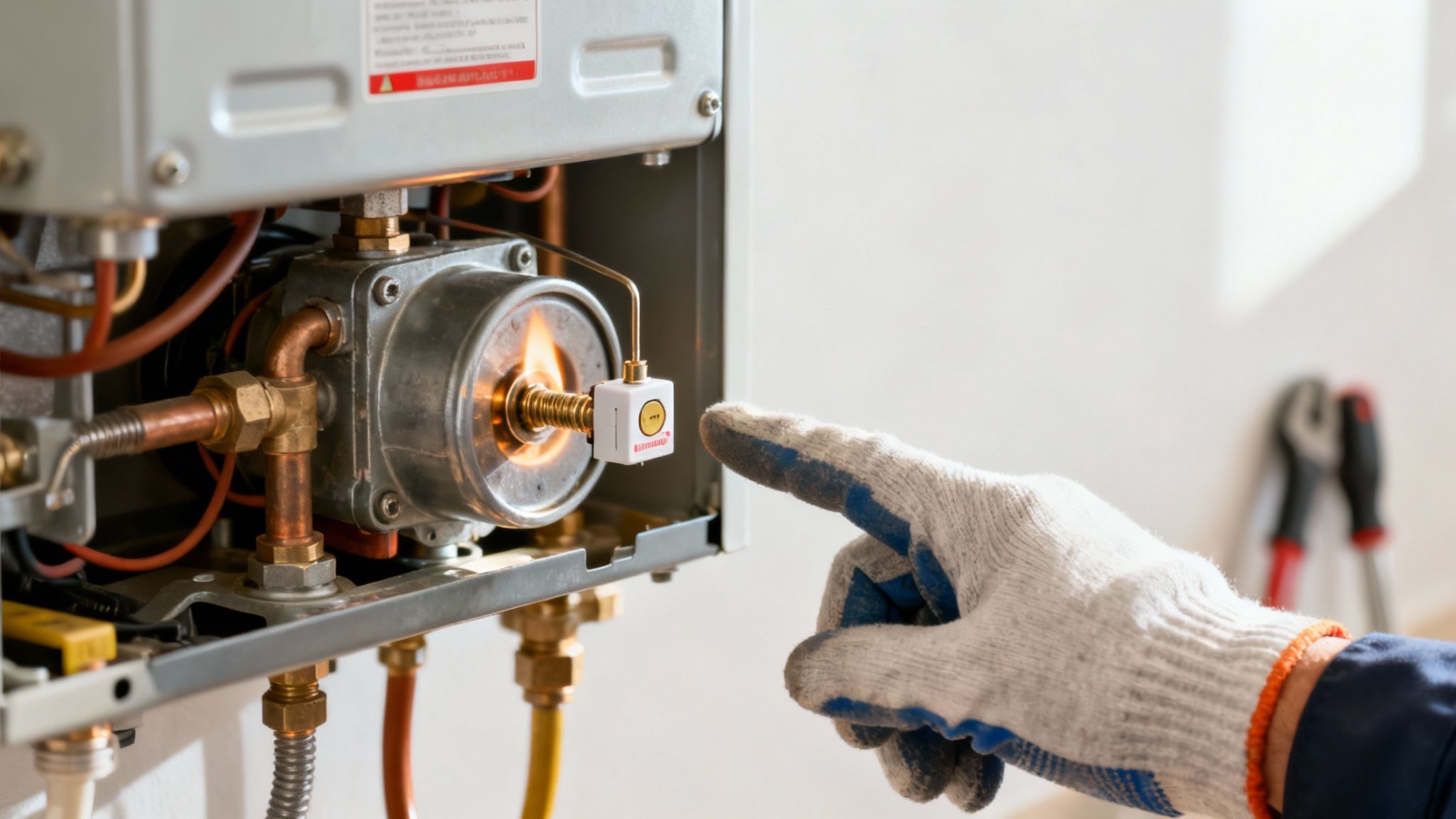
DIY know-how is great, but when it comes to a gas water heater, knowing your limits isn't just about avoiding a bigger repair bill—it's about keeping your family safe. There’s a clear line between a quick fix and a serious hazard, and it's important to recognize when it's time to call a professional plumber in Los Angeles.
It’s surprisingly easy to turn a small, manageable problem into a major disaster. Any repair involving gas lines or complex electrical components is firmly in "pro-only" territory. The real goal of troubleshooting is to figure out what the problem is, not necessarily to fix it yourself.
Non-Negotiable Emergency Calls
Some signs are absolute, drop-everything red flags. These aren't suggestions; they are critical safety warnings that mean you need a licensed Los Angeles plumber on the phone, period.
The Smell of Gas: If you catch that distinct "rotten egg" smell, you have a potential gas leak. Don't touch any light switches or electronics. Get everyone out of the house immediately. From a safe distance, call your gas company's emergency line first, then a plumber.
A Major Tank Leak: See a steady stream of water or a fast-growing puddle coming from the tank itself? That almost always means the inner tank has failed, and it can't be patched up. You need to shut off the water and gas supply to the unit right away and call for an emergency replacement.
Visible Soot or Scorch Marks: Black soot building up around the base of the heater or on the vent pipe is a dead giveaway that it's not burning fuel correctly. This is dangerous because it can release deadly carbon monoxide gas into your home.
When Recurring Problems Signal Deeper Issues
Sometimes, the issue isn't one big failure but a nagging problem that just won't quit. If you find yourself relighting the pilot light every other day, that's not just an annoyance. It's a clear symptom of a deeper failure that a simple fix can't solve.
Things like a constantly extinguishing pilot, rumbling noises that persist even after a tank flush, or hot water that cuts in and out are all signs of a failing component. It could be the gas control valve, the thermocouple assembly, or something else entirely. This is where a professional's diagnostic tools and experience are invaluable.
Homeowners often underestimate how interconnected the components of a gas water heater are. A recurring issue in one area might be caused by a less obvious problem somewhere else in the system. A licensed plumber has the diagnostic tools and experience to trace the problem back to its true source, saving you from a cycle of temporary fixes.
Navigating Los Angeles Codes and Safety Upgrades
Bringing in a pro is also about making sure your system is safe and up to code. Los Angeles County has very specific regulations for water heater installation, venting, and safety features that you simply can't ignore.
A licensed plumber guarantees that any repair or replacement meets these local standards. This is especially true for California-specific safety requirements. For instance, having an automatic earthquake shut-off valve on your gas line is a critical safety measure here. These valves are designed to instantly cut the gas supply during a tremor, preventing a potential fire or explosion.
The demand for expert service is growing, with the global water heater repair market valued at $15 billion in 2025 and continuing to expand. For local LA providers like ZH Plumbing, this shows just how much homeowners value professional, compliant installations. You can find more details about the water heater repair market on datainsightsmarket.com.
When you do need to call for backup, finding a trustworthy local plumber is key. It can be helpful to understand how plumbing companies ensure local SEO wins to get a sense of how reputable pros make themselves visible in your area.
Ultimately, calling a professional is the smart, safe choice for any issue you aren't 100% comfortable handling. If you're facing a tricky problem or just want peace of mind that your water heater is installed correctly and safely, we’re here to help. Take a look at our guide on choosing a trustworthy plumbing company for more tips.
Frequently Asked Water Heater Questions
When you're staring down a malfunctioning gas water heater, a lot of questions pop into your head. Homeowners all over Los Angeles ask us the same things, wondering about everything from how long their unit should last to whether it’s worth fixing. We've gathered the most common questions right here to give you some straightforward answers based on our years of experience in the field.
These aren't just generic answers, either. We're talking about the realities of owning a water heater in Southern California, where things like our notoriously hard water can really change the game. Getting a handle on these details can save you a lot of grief and money down the road.
How Long Should a Gas Water Heater Last in Southern California?
You'll often hear that a standard tank-style gas water heater is built to last somewhere between 8 and 12 years. And that's a decent ballpark, but here in the Greater Los Angeles area, reality often hits a little differently. We frequently see that lifespan get cut short, and the main reason is our hard water.
Our water is packed with minerals like calcium and magnesium, which settle at the bottom of your tank over time. This creates a nasty layer of sediment that acts like a barrier, forcing the burner to work overtime just to heat the water. All that extra strain causes significant wear and tear. It’s exactly why we're so big on regular maintenance, especially annual tank flushing, for our clients from Glendale to Pasadena.
Simply put, without that consistent maintenance to fight off mineral scale, your heater might start giving up the ghost closer to the 8-year mark. But a well-cared-for unit? We've seen plenty of those push right past the 12-year average, giving you much more bang for your buck.
Is It Better to Repair or Replace My Old Water Heater?
This is the big one. It's the question every homeowner faces when a major water heater problem crops up, and the answer usually comes down to simple math.
A great rule of thumb we use in the industry is the 50% rule. If your water heater is over halfway through its expected life (let's say it's 7 years or older) and a repair is going to cost more than 50% of a brand-new unit, replacement is almost always the smarter move. It just doesn't make financial sense to keep dumping money into an aging appliance that’s likely to fail again soon.
For many homeowners, the decision to replace isn't just about avoiding another repair. It’s an opportunity to upgrade to a more energy-efficient model, which can lead to significant savings on your gas bill over the long term.
Here’s a quick checklist to help you decide:
Age of the Unit: Is it pushing past 10 years? If so, replacement should be at the top of your list.
Frequency of Repairs: Has it been a while since your last service call, or are we becoming regulars at your house? Constant issues are a huge red flag that internal parts are wearing out.
Visible Rust or Corrosion: If you see significant rust on the tank itself or notice rusty, brown water from your taps, the tank is corroding from the inside out. Replacement isn't just an option—it's necessary.
It can be a tough call, but our team is here to help you weigh the pros and cons. To get even more detail, check out our guide on the key factors when deciding to repair or replace your water heater.
What Maintenance Can I Do Myself to Prevent Problems?
A little preventative care can be your best weapon against a cold shower on a Monday morning. While some jobs definitely require a pro, there are a couple of simple things any homeowner can do once a year to keep their water heater happy and spot trouble before it starts.
First up, test the Temperature and Pressure (T&P) Relief Valve. This is a critical safety feature designed to open up if the pressure or temperature inside the tank gets dangerously high. Grab a bucket and place it under the discharge pipe. Lift the little lever for a few seconds to let a quick burst of hot water out, then let it snap closed. If it keeps dripping afterward or if no water comes out at all, that valve needs to be replaced by a professional right away.
Next, give it a good visual inspection. At least twice a year, grab a flashlight and take a look around the entire unit. You’re looking for:
Small drips coming from any of the pipe fittings or valves.
Black soot or charring marks around the burner chamber at the bottom.
Any rust spots or signs of corrosion on the tank's exterior.
Catching these little things early is the core of troubleshooting your gas water heater before a small hiccup turns into a full-blown emergency. These checks only take a few minutes, but they can make a world of difference for your heater's lifespan.
If you're staring at a water heater problem that's more than you want to handle, or you'd just rather have the peace of mind that comes with professional service, the team at ZH Plumbing is here to help. We offer reliable, expert solutions for homeowners across Los Angeles and surrounding areas, from emergency repairs to brand-new installations. Contact us for prompt and professional service. https://zhplumbing.com
Comments