

.png)

A Homeowner's Guide to Water Filtration Systems for Homes
Wondering what’s really in your tap water? Does it taste slightly of chlorine, or do you constantly fight hard water stains on your faucets and dishes? A home water filtration system is your final line of defense, catching the impurities, contaminants, and excess minerals that make it through the municipal supply. It’s the key to ensuring the water you drink, cook with, and bathe in is as clean and safe as possible.
Is Your Los Angeles Tap Water As Clean As You Think?
You fill a glass from your kitchen tap and hold it up to the light. Is it as clear as you'd like? While Los Angeles provides treated water that meets legal safety standards, that doesn't always mean it's perfect. From a distinct chlorine aftertaste to the hard water stains that plague faucets from Santa Monica to Pasadena, many residents have reason to be concerned.
The journey from the treatment plant to your home is a long one. As water travels through miles and miles of pipes, it has plenty of opportunities to pick up things you’d rather not drink.
The Journey to Your Faucet
Before water reaches your glass, it can collect a host of unwanted hitchhikers. Understanding these potential issues is the first step toward finding the right filtration solution.
Here are the top concerns for LA residents:
Disinfection Byproducts: Chlorine and chloramine are essential for killing bacteria, but they can leave an unpleasant chemical taste and smell.
Hard Water Minerals: High levels of calcium and magnesium are the culprits behind limescale buildup. This damages appliances, clogs pipes, and leaves stubborn white spots on your dishes and faucets.
Contaminants from Aging Pipes: Older plumbing infrastructure can sometimes leach particles or even metals into the water. If your home has older pipes, it's worth learning about the signs your home may need new plumbing pipes.
According to the Environmental Working Group's Tap Water Database, many utilities in the Los Angeles area have contaminants that, while within legal limits, are well above levels recommended by scientists for optimal health.
This reality is what leads so many homeowners to look for a final, reliable barrier of protection. A high-quality water filtration system for your home gives you that peace of mind, putting you back in control. It tackles the issues that municipal treatment alone can't solve, making sure every drop is as pure as possible.
Choosing Your Filtration Strategy: Point-of-Use vs. Whole-Home
When considering a water filtration system, the first big question is: do you need to purify water at one specific tap, or do you want clean, filtered water flowing through your entire house? This decision comes down to two main approaches: Point-of-Use (POU) and Whole-Home, also called Point-of-Entry (POE) systems.
Think of it like this: a POU filter is a specialist, like a personal chef at your kitchen sink, focused on making sure your drinking water is exceptionally pure.
A Whole-Home system is like a security guard at your main water line. It inspects and treats every drop that enters your home, so your faucets, showers, and appliances all get the good stuff.
What Is a Point-of-Use (POU) System?
A Point-of-Use system filters water right where you use it, typically at a single faucet. These are usually compact units that fit neatly under the kitchen sink or attach directly to the tap. Their main job is to provide top-quality water for drinking and cooking.
Best For: Renters or homeowners primarily concerned with the taste and quality of the water they consume.
Common Examples: Under-sink reverse osmosis units, countertop pitchers, and faucet-mounted filters.
Key Advantage: POU systems are fantastic at removing a high concentration of specific contaminants from a smaller amount of water, making advanced technologies like reverse osmosis effective and affordable for targeted use.
For many people, this is a perfect starting point. Just remember, a POU filter in the kitchen won't do anything about the hard water scale building up in your showerhead or the chlorine you might absorb through your skin while you bathe.
This decision tree can help you see if your water worries point toward a single-faucet solution or a more comprehensive strategy.
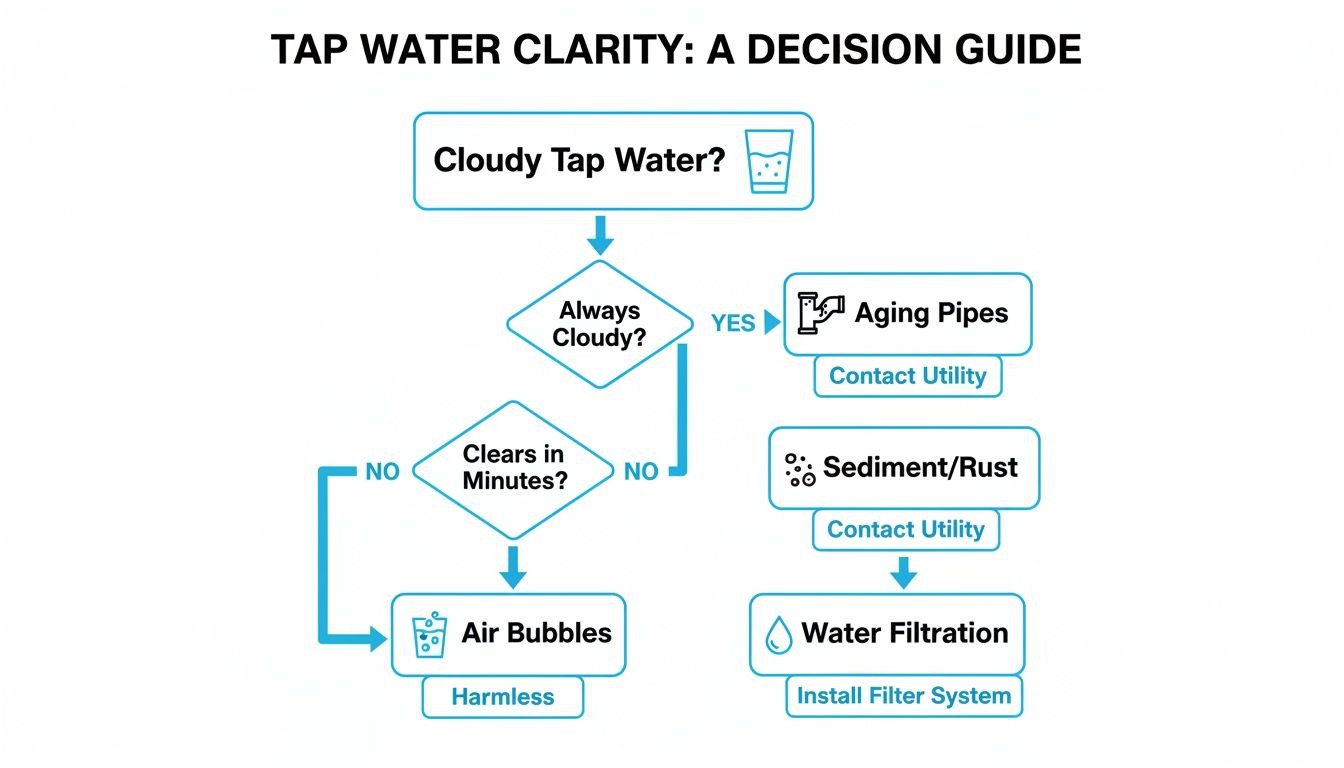
As the chart suggests, issues like cloudy water can often be traced back to aging city infrastructure, making a home filtration system a direct fix for restoring clarity and purity.
What Is a Whole-Home (POE) System?
A Whole-Home system connects directly to your main water line, purifying every gallon of water that enters your house. This means every tap—from the bathroom sink and shower to the washing machine—delivers filtered water.
This strategy is quickly becoming the standard. The residential sector is by far the biggest market for water treatment systems, and it's easy to see why. People are more health-conscious, and there's growing concern over our aging municipal water infrastructure, which can sometimes lead to 15-20% higher contaminant levels by the time water reaches your home.
While POU systems are great for their simplicity, POE units are a game-changer for households in Los Angeles, from Hollywood to Santa Monica, dealing with hard water and other common issues.
A Whole-Home system is an investment in the health of both your family and your home's plumbing. By removing chlorine, sediment, and hard minerals at the source, it protects your pipes and appliances from costly damage while improving your skin and hair health.
Choosing this route gives you seamless protection. You never have to think about which tap is safe for a drink because every source provides the same high-quality water. For homeowners looking to make a serious improvement, a Whole-Home system is one of the smartest eco-friendly plumbing upgrades for Pasadena homeowners you can make.
To make things even clearer, let's break down the key differences.
POU vs. Whole-Home Systems At A Glance
Feature | Point-of-Use (POU) System | Whole-Home (POE) System |
|---|---|---|
Coverage | Filters water at a single tap (e.g., kitchen sink). | Filters all water entering the home. |
Installation | Simpler, often DIY-friendly (faucet-mounted) or minor plumbing (under-sink). | Requires professional installation on the main water line. |
Upfront Cost | Generally lower, from $50 to $500+. | Higher investment, typically $1,000 to $4,000+. |
Maintenance | Frequent filter changes (every 2-6 months). | Less frequent but larger filter changes (every 6-12 months or longer). |
Best For | Targeting drinking/cooking water, renters, budget-conscious buyers. | Addressing widespread issues like hard water, chlorine, and sediment throughout the entire house. |
Limitations | Does not protect appliances, showers, or other taps. | Higher initial cost and larger physical footprint. |
This table gives you a quick snapshot, but the best choice always depends on your specific water quality and what you're trying to achieve for your home.
Understanding The Technologies That Purify Your Water
Choosing the right water filtration system for your home feels less intimidating once you understand how the different technologies work. Think of each method as a specialized tool designed for a specific job.
Each one targets different troublemakers in your water, working to give you the clean, safe, and great-tasting water your family deserves.
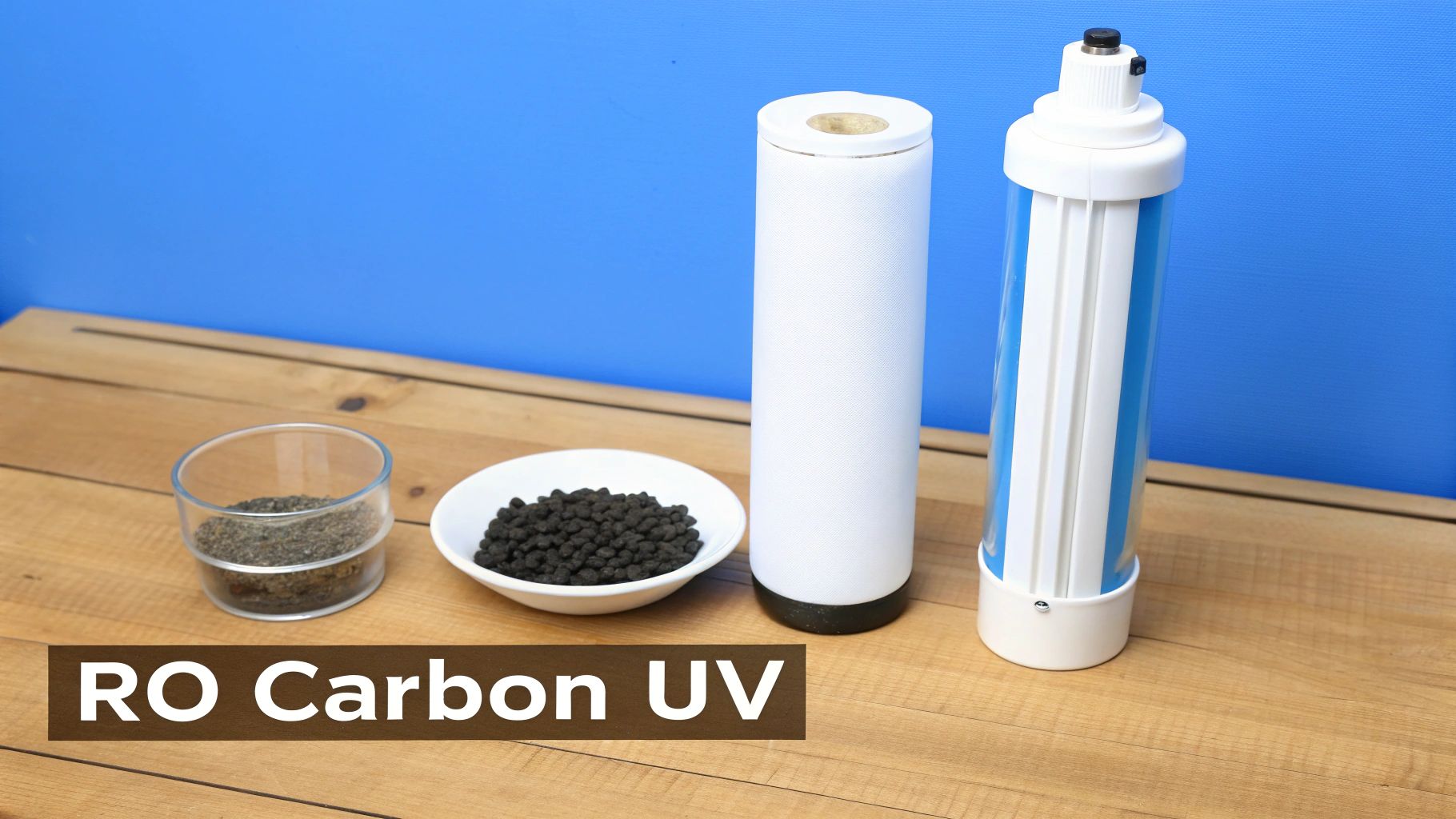
Let's break down the core technologies powering modern filtration and see which common Los Angeles water problems they solve.
Reverse Osmosis: The Purity Powerhouse
Imagine a high-tech net so fine it operates at a molecular level. That's the heart of a Reverse Osmosis (RO) system. It uses your home's water pressure to push water through a special membrane with pores so tiny that almost nothing but pure H₂O molecules can squeeze through. This powerful process catches a huge range of dissolved solids most other filters can't touch.
What it removes: Heavy metals like lead and arsenic, fluoride, nitrates, salts, and even trace pharmaceuticals.
Best for: Anyone aiming for the highest possible level of purity for drinking and cooking, especially if you're concerned about specific dissolved contaminants.
Because of its effectiveness, RO can eliminate up to 99% of all dissolved contaminants, which is why it's a cornerstone for so many homeowners in the Greater Los Angeles area who partner with ZH Plumbing to meet strict health standards.
Activated Carbon: The Magnetic Sponge
If you've ever used a Brita pitcher, you're already familiar with Activated Carbon. Think of it as a magnetic sponge. The carbon is treated to create millions of microscopic pores, giving it a massive surface area. As water flows past, these pores act like magnets, grabbing and holding onto chemical contaminants in a process called adsorption. This is your go-to solution for improving the taste and smell of your tap water.
Key Takeaway: Activated carbon is your frontline defense against that "pool water" taste and smell. It's what makes your tap water taste crisp, clean, and refreshing again.
You'll find this workhorse technology in everything from simple faucet filters to advanced whole-home systems.
UV Purifiers: The Guardian of Light
Unlike filters that physically trap contaminants, an Ultraviolet (UV) Purifier is a sterilizer. It uses a special lamp to zap the water with powerful UV-C light, which scrambles the DNA of living microorganisms like bacteria and viruses. This doesn't kill them, but it renders them completely harmless and unable to reproduce. Think of it as a microscopic security checkpoint that neutralizes biological threats without adding any chemicals to your water.
What it zaps: Bacteria (E. coli), viruses, and protozoa like Giardia and Cryptosporidium.
Best for: Homes on well water or anyone who wants an extra, failsafe layer of protection against germs.
A big part of water purification is figuring out how to remove bacteria from drinking water, and UV is one of the most effective and chemical-free ways to do it.
Water Softeners: The Mineral Exchangers
Hard water is the reason for that chalky soap scum on your shower doors and the damaging scale buildup inside your pipes and appliances. A Water Softener is the only tool specifically built to solve this problem.
It doesn't "filter" in the traditional sense. Instead, it uses ion exchange. The softener tank is filled with tiny resin beads covered in sodium ions. As hard water passes through, the calcium and magnesium ions—the minerals that make water "hard"—are drawn to the resin and swapped for sodium ions. The result is "soft" water that lathers beautifully, leaves your dishes spot-free, and protects your entire plumbing system from limescale.
If you're dealing with hard water and want to tackle other purity issues, you can get a comprehensive water filtration system that combines softening with other methods. By matching these technologies to your home's unique water profile, you can build a solution that delivers truly pristine water.
Budgeting for Pure Water: Installation Costs And Upkeep
Putting a quality water filtration system in your home is a smart investment in your family's health and your plumbing's longevity. But before you can enjoy pure, clean water from every tap, it helps to understand the full financial picture. The total cost includes the system itself, professional installation, and regular upkeep to keep it running at peak performance. This breakdown will give you a clear idea of what to expect.
Understanding Upfront Investment Costs
The initial cost is the biggest piece of the puzzle. This covers both the filtration unit and the skilled labor to install it perfectly. Simpler systems are easier on the wallet, while comprehensive whole-home solutions represent a more significant—but often more impactful—investment.
Point-of-Use (POU) Systems: An under-sink reverse osmosis system, which provides incredible drinking water at your kitchen faucet, typically runs between $300 to $1,500 installed. The price varies based on the number of filtration stages and extras like a remineralization cartridge.
Whole-Home (POE) Systems: A whole-home carbon filter or a water softener is a bigger project, usually ranging from $1,500 to $5,000+ installed. These systems are true workhorses, protecting your entire plumbing infrastructure and every water-using appliance.
We understand that the upfront cost can be a hurdle. That’s why exploring options like homeowner customer financing can be a game-changer. It makes even advanced systems accessible by letting you spread the cost over time.
Planning for Ongoing Maintenance and Upkeep
Once your system is installed, it requires routine maintenance to keep doing its job. This mostly means swapping out filter cartridges and other components on a schedule. Forgetting this step is like never changing the oil in your car—eventually, the system won't work as it should.
The long-term value of a filtration system often pays for itself. The average American household can save over $600 per year by eliminating the need for bottled water, not to mention the savings from preventing costly appliance repairs caused by hard water scale.
This is where you see the return on your investment. By budgeting for small, predictable maintenance costs, you sidestep much larger, unexpected repair bills down the road.
Estimated Costs and Maintenance Schedule
To help you get a sense of the numbers, here is a summary of typical upfront costs and ongoing maintenance for the most common filtration technologies.
Filtration Type | Estimated Upfront Cost (Installed) | Annual Maintenance Cost | Maintenance Frequency |
|---|---|---|---|
Reverse Osmosis (Under-Sink) | $300 - $1,500 | $100 - $300 | Filters every 6-12 months; membrane every 2-3 years. |
Activated Carbon (Whole-Home) | $1,500 - $3,500 | $150 - $400 | Main carbon media every 3-5 years; pre-filters annually. |
Water Softener (Whole-Home) | $2,000 - $5,000+ | $100 - $250 (Salt) | Refill salt monthly; resin bed lasts 10-15+ years. |
UV Purifier (Add-On) | $400 - $1,200 | $75 - $150 | Replace UV lamp and quartz sleeve annually. |
Thinking about these costs from the start ensures there are no surprises. A well-maintained system is an asset that provides clean, safe water for years, protecting both your family and your home’s plumbing. If you have questions about which system fits your budget, our team can provide a clear, no-pressure assessment to find the perfect fit.
How To Select The Right Filtration System For Your LA Home
Now that we’ve walked through the technologies and costs, you're ready to make a decision. Choosing the right water filtration system for your home isn’t about picking the “best” product online—it's about finding the best fit for your home and your water. A system that’s perfect for a house in Pasadena might be wrong for a condo in Santa Monica. This section is a practical guide to help you zero in on what makes the most sense for you.

Start With Your Water Quality
Before you do anything else, you need to know what you’re trying to remove from your water. Don't guess. This is the single most important step and will immediately narrow your options.
Review Your Local Water Report: Utilities like the LADWP publish an annual Consumer Confidence Report (CCR). This document is a great starting point, showing where your water comes from and what contaminants have been detected.
Consider Professional Water Testing: A CCR is a good overview, but it doesn't tell you what’s happening inside your home's pipes. A professional water test gives you a precise snapshot of the water from your tap, which is crucial for spotting things like lead from old plumbing or specific hardness levels that can vary from block to block.
A home in the San Fernando Valley might find its biggest problem is extremely hard water, making a water softener the obvious choice. Meanwhile, a family in Glendale with balanced minerals might want an activated carbon filter to remove the chlorine taste.
Ask The Right Questions About Your Home
Once you know your water’s profile, look at the practical side of things. Your answers here will quickly point you toward either a point-of-use or a whole-home solution.
1. What's Your Budget?As we've covered, upfront costs range from a few hundred dollars for an under-sink system to several thousand for a comprehensive whole-home setup. Be realistic, but also factor in long-term savings from ditching bottled water and protecting your appliances.
2. How Much Space Do You Have?An under-sink RO system is compact and fits in a kitchen cabinet. A whole-home system needs a dedicated spot—usually in the garage, basement, or near your main water shut-off valve. Measure your space before choosing a system.
3. Do You Rent Or Own?This is a big one. Renters are typically limited to non-permanent options like faucet filters or countertop units. Homeowners have the freedom to install a whole-home system, a significant upgrade that can add to your property's value.
4. What Is Your Water Usage?Consider your household size. A large family running the dishwasher and washing machine daily has different needs than a single person in a condo. Ensure any system you consider has a flow rate that can keep up without causing a frustrating drop in water pressure.
The Critical Role Of Professional Installation
While screwing on a faucet filter is an easy DIY win, installing a whole-home system is a different ballgame. It involves cutting into your main water line, a job that should always be left to a licensed and insured plumber.
Here’s why professional installation is non-negotiable:
Safety and Compliance: A professional ensures the installation meets all local plumbing codes in Los Angeles County, preventing leaks and water damage.
Optimal Performance: An expert will correctly size the system for your home's flow rate, so you get clean water without sacrificing water pressure.
Warranty Protection: Most manufacturers will void their warranties if the system isn't installed by a certified professional.
Choosing the right system is the first step, but proper installation guarantees it will work correctly for years. If you need more guidance on finding the right expert, our guide on how to choose the right plumbing professional for your home has valuable tips.
Your Top Water Filtration Questions, Answered
Even after digging into the options, it's normal to have a few questions. Let's tackle some of the most common ones we hear from homeowners in Los Angeles to clear up any confusion and help you feel confident in your decision.
Do Water Filters Remove Healthy Minerals?
This depends on the type of filter. A Reverse Osmosis (RO) system is designed to pull out nearly everything, which includes beneficial minerals. However, many modern RO systems have a remineralization stage that adds healthy minerals like calcium and magnesium back into the water, giving you pure water that still tastes great.
On the other hand, activated carbon filters and UV purifiers are more targeted. They go after specific things like chlorine and bacteria without touching the mineral content. A water softener simply swaps "hard" minerals for sodium. We can help you pick a system that matches your health goals.
How Often Should I Change My Water Filters?
This comes down to the specific system and your family's water usage. As a general rule, follow the manufacturer's schedule.
For most sediment and carbon filters, this means a replacement every 6 to 12 months. The membrane in an RO system can last much longer, typically 2 to 3 years. The easiest way to know it's time is a drop in water pressure or the return of odd tastes and smells. Many modern water filtration systems for homes have indicator lights or timers that take the guesswork out of it.
Will A Whole-Home Filter Lower My Water Pressure?
When a whole-home system is sized correctly and installed by a professional, you should not notice any drop in water pressure. A significant pressure loss almost always points to one of two things:
The system is too small for your home's water demand.
The filter is clogged and overdue for a change.
An experienced plumber ensures the system is a perfect match for your home’s flow rate from the start, so this never becomes an issue.
Beyond water purity, it’s smart to protect your home from any water-related issues. A common question is, Does Homeowners Insurance Cover Water Damage?, which is a great resource for understanding how to protect your property from leaks or system failures.
Ready to get a clear, expert opinion on your home's water? The team at ZH Plumbing is here to provide a professional assessment tailored to your L.A. home, your family’s needs, and your budget.
Comments