

.png)

Cost of Tankless Water Heater Installed in Los Angeles
Tired of running out of hot water mid-shower or staring at a high energy bill? If you're considering a tankless water heater, your first question is probably about the price. In the Greater Los Angeles area, the total cost of a tankless water heater installed typically ranges from $2,800 to over $6,000, with most homeowners landing somewhere in the middle.
That price covers both the unit and professional installation, but the final number on your invoice depends heavily on your home's specific needs. Let's break down what goes into that cost so you can budget with confidence.
A Quick Guide to Los Angeles Installation Costs
Switching to a tankless water heater is a smart move for endless hot water and long-term energy savings. However, the initial investment can feel significant, and unexpected costs are everyone's least favorite surprise.
Understanding the price breakdown ahead of time helps you plan. The total cost isn't just the sticker price of the heater; it’s a combination of the unit, the skilled labor for installation, and any necessary upgrades to your home’s plumbing, gas, or electrical systems to support it.
Here in a market like Los Angeles, local factors are key. For instance, installing a new tankless system in a beautiful older home in Hollywood might require more retrofitting than a straightforward swap in a newer property.
Understanding the Price Range
The cost of a tankless water heater installation varies so much because several key factors are involved. It's like buying a car—a basic model gets the job done, but if you want more power or premium features, the price increases. The same applies to water heaters:
Unit Type and Size: A high-capacity gas model from a top-tier brand will naturally cost more than a smaller electric unit designed for a condo.
Installation Complexity: This is a major factor. Moving from a traditional tank heater often requires running new venting, upgrading gas lines for higher demand, or adding new electrical circuits.
Labor Rates: The cost for a licensed, experienced plumber will vary based on their expertise and your location within the Greater LA area.
To give you a clearer picture, here’s a table breaking down the typical costs you can expect for a gas model installation in our area.
Average Tankless Water Heater Installation Cost Breakdown (Los Angeles)
This table summarizes the typical costs associated with installing a new tankless water heater, providing a clear overview of where your money goes.
Cost Component | Typical Price Range (Gas Models) | Key Details |
|---|---|---|
Tankless Unit | $1,000 – $2,500+ | Price depends on brand (e.g., Noritz, Navien), flow rate (GPM), and energy efficiency rating. |
Labor & Installation | $1,200 – $3,000 | Includes removing the old tank, mounting the new unit, and all plumbing connections. More complex jobs cost more. |
Materials & Supplies | $300 – $800 | Covers new pipes, valves, fittings, venting materials, and mounting hardware. |
Permits | $150 – $400 | Required by most LA-area municipalities to ensure the installation meets safety and building codes. |
Potential Upgrades | $200 – $1,500+ | This can include upsizing the gas line, adding a dedicated electrical circuit, or installing a water softener. |
Keep in mind that these are averages. A straightforward swap will be on the lower end, while a complex retrofit in an older home will push toward the higher end of these ranges.
What Averages Say About Local Costs
Drilling down into the numbers, recent local data helps paint an even clearer picture. A detailed analysis shows that the average cost to install a tankless water heater in major markets like Greater Los Angeles typically falls between $2,781 and $3,222 per unit.
Within that figure, the heater itself—a popular gas model—usually accounts for $1,647 to $1,852 of the total. The rest is made up of labor and materials, which can change from one zip code to the next. That's a critical detail for homeowners across LA County.
Having this baseline gives you a solid starting point for your budget. With these numbers in hand, you can move forward with confidence as you plan your upgrade. The sections below will dig into each of these cost factors, helping you build an even more accurate estimate for your home.
Breaking Down the Core Cost Components
When you receive a quote for a new tankless water heater, the total cost is a combination of three key elements: the heater itself, the professional labor to install it, and any required city permits.
Understanding these components helps you see exactly where your money is going and why the price can vary from one home to the next.
The Tankless Water Heater Unit
First up is the largest expense: the actual tankless heater. This isn't a one-size-fits-all appliance. The price is shaped by a few critical factors that determine its performance and longevity.
Fuel Source: Your main choice is between natural gas and electric. Gas models usually cost more upfront but often save you money on utility bills over time, which is a big advantage for larger households.
Size and Flow Rate (GPM): A unit's power is measured in Gallons Per Minute (GPM). A busy home with multiple bathrooms and appliances running simultaneously will need a higher GPM unit, which costs more than a smaller unit suited for a condo.
Brand and Efficiency: Just like with cars, premium brands known for reliability and top-tier energy efficiency ratings come with a higher price tag. However, that initial investment often pays for itself through lower energy bills year after year.
In high-demand areas like Los Angeles, gas tankless heaters are the most popular choice. A full installation can run anywhere from $2,100 to $5,600. This is often more than electric models, which tend to be in the $1,400 to $3,000 range. The gas unit alone can be $1,500 to $2,600, making it a smart investment for larger homes that need 8-10 GPM of endless hot water.
Professional Labor and Installation
The second pillar is the professional labor required for a safe and correct installation. This is where a licensed plumber's expertise is crucial, and the cost can vary significantly depending on the job's complexity. A proper installation ensures safety, peak efficiency, and compliance with local building codes.
The simplest and least expensive jobs are direct swap-outs—replacing an old tankless unit with a new one. However, for most homeowners, especially those in older L.A. homes, the project is a retrofit.
A "retrofit" is the process of switching from a traditional tank-style water heater to a modern tankless system. It’s often a bigger job because it can involve major changes to your home's existing plumbing, gas lines, and venting system, making it more labor-intensive and expensive.
Common tasks that can increase labor costs include:
Upgrading your gas line to handle the higher demand of a gas heater.
Running new, dedicated electrical wiring for an electric model.
Installing brand-new venting through your roof or an exterior wall.
Relocating the unit to a different spot in your home.
Because every home is unique, getting a detailed, on-site quote is the only way to get a truly accurate price. It’s also helpful for homeowners to know about common mistakes in plumbing service estimating to better understand their quote. Spotting potential issues early can save you a bundle, so check out our guide on how to avoid these common water heater mistakes that could drain your wallet.
City Permits and Inspection Fees
The final, and often forgotten, piece of the puzzle is the cost of permits. From Santa Monica to Pasadena, most cities in Los Angeles County require a permit for any new water heater installation. This isn't just bureaucratic red tape—it's a critical safety measure.
Pulling a permit ensures that the installation is done correctly and meets all current building and safety codes. After the job is complete, a city inspector provides official approval, checking everything from gas connections and venting to seismic strapping. This entire process is designed to protect you, your family, and your home.
Permit fees typically fall between $150 and $400. Your plumbing contractor will almost always handle the entire process for you, from applying for the permit to scheduling the final inspection.
Budgeting for Necessary Upgrades and Hidden Costs
The quote from your plumber will cover the essentials—the unit, labor, and permits. But what about potential surprises? The final cost of a tankless water heater installation can sometimes increase, especially when retrofitting an older Los Angeles home in neighborhoods like Hollywood or Glendale.
Many of these properties were built long before today's high-demand tankless systems existed. To get one running safely and effectively, you might need to invest in a few upgrades that aren't part of a standard quote. Planning for these potential "hidden" costs is the key to creating a realistic budget and avoiding sticker shock.
Upgrading Your Gas Line for Proper Flow
One of the most common additional costs for gas tankless models is a gas line upgrade. Your old tank heater sipped gas, but a powerful tankless unit needs to gulp it to heat water instantly. If your existing gas pipe is too narrow (often just ½-inch), it can't deliver enough fuel.
When the unit is "starved" for gas, you get lackluster performance, lukewarm showers, and frustrating error codes. To fix this, your plumber will need to replace a section of the pipe with a larger ¾-inch or 1-inch line.
Why It's Needed: This ensures the heater gets enough fuel (measured in BTUs) to work at its best and meet your family's hot water needs.
Estimated Cost: This job can add $300 to $800+ to your total, depending on the length of pipe that needs replacing and how difficult it is to access.
This is not an optional tweak; it's non-negotiable for performance and safety. An undersized gas line is perhaps the single biggest reason for dissatisfaction with a new tankless heater.
Addressing Electrical and Venting Requirements
Beyond the gas line, two other critical systems often need attention: your electrical wiring and the unit's venting. Both are essential for operating your new heater safely.
If you choose an electric tankless model, be aware that they are power-hungry. Most homes will need a new, dedicated circuit run directly from the main electrical panel to the unit. This is a job for a licensed electrician and can cost anywhere from $250 to over $1,000, based on the distance and complexity of the run.
For high-efficiency gas models, proper venting is a major consideration. Old tank heaters often used an existing chimney, but modern condensing units require special sealed plastic venting (usually PVC or CPVC) to operate correctly.
Installing a new vent system usually means drilling through an exterior wall or running a new pipe straight up through the roof. This makes sure all exhaust gases are safely pushed outside, eliminating any risk of carbon monoxide getting into your home.
Crucial Safety Upgrades for Los Angeles Homes
Living in Southern California, we all know we have to be prepared for earthquakes. A vital safety upgrade that is frequently required—and something we always recommend—is an automatic seismic gas shut-off valve. This device is installed on your main gas line and automatically shuts off the gas during a major earthquake (typically a magnitude 5.4 or higher). This simple device can prevent a catastrophic gas leak and potential fire.
Additionally, if the installation uncovers old or corroded pipes, addressing them becomes a top priority. You can learn more about the signs your home may need new plumbing pipes in our detailed guide. It's always smart to plan for the entire investment, which includes preparing for unforeseen issues. Understanding typical water damage cleanup costs can also put the importance of proactive plumbing maintenance into perspective. By accounting for these potential upgrades, your budget will be a much more accurate reflection of the true final cost.
Comparing Costs Across Different Brands and Models
When you start shopping for a tankless water heater, you'll find they aren't all the same. The specific model you choose plays a huge role in the total cost of a tankless water heater installed—both upfront and in long-term utility expenses. To make the right decision, you need to understand the real differences between your options.
First, consider the fuel source. Your main choices are natural gas, propane, or electric. Here in the Greater Los Angeles area, natural gas is the most common and typically most affordable option, which is why most single-family homes use gas-powered tankless units. They deliver powerful performance but require more involved installation for venting and gas lines.
Electric models, on the other hand, are often cheaper to purchase and simpler to install since they don't require venting. The trade-off is that their operating costs can be higher, and a single unit may struggle to keep up with the hot water demands of a larger family.
Premium vs. Budget-Friendly Brands
After choosing a fuel type, you’ll look at brands. The market is generally split between high-end, premium brands and more budget-friendly alternatives. Each has its advantages.
Premium Brands (e.g., Navien, Rinnai): These are industry-leading names known for incredible energy efficiency, strong warranties, and advanced features like built-in recirculation pumps for instant hot water. You are paying more for this level of quality and engineering.
Budget-Friendly Brands: You can still find reliable performance from other brands at a lower price point. They might not have all the bells and whistles or the highest efficiency ratings, but they are a great choice for homeowners with a tighter budget or more modest hot water needs.
Regardless of the brand, remember that the installation itself can come with extra costs.
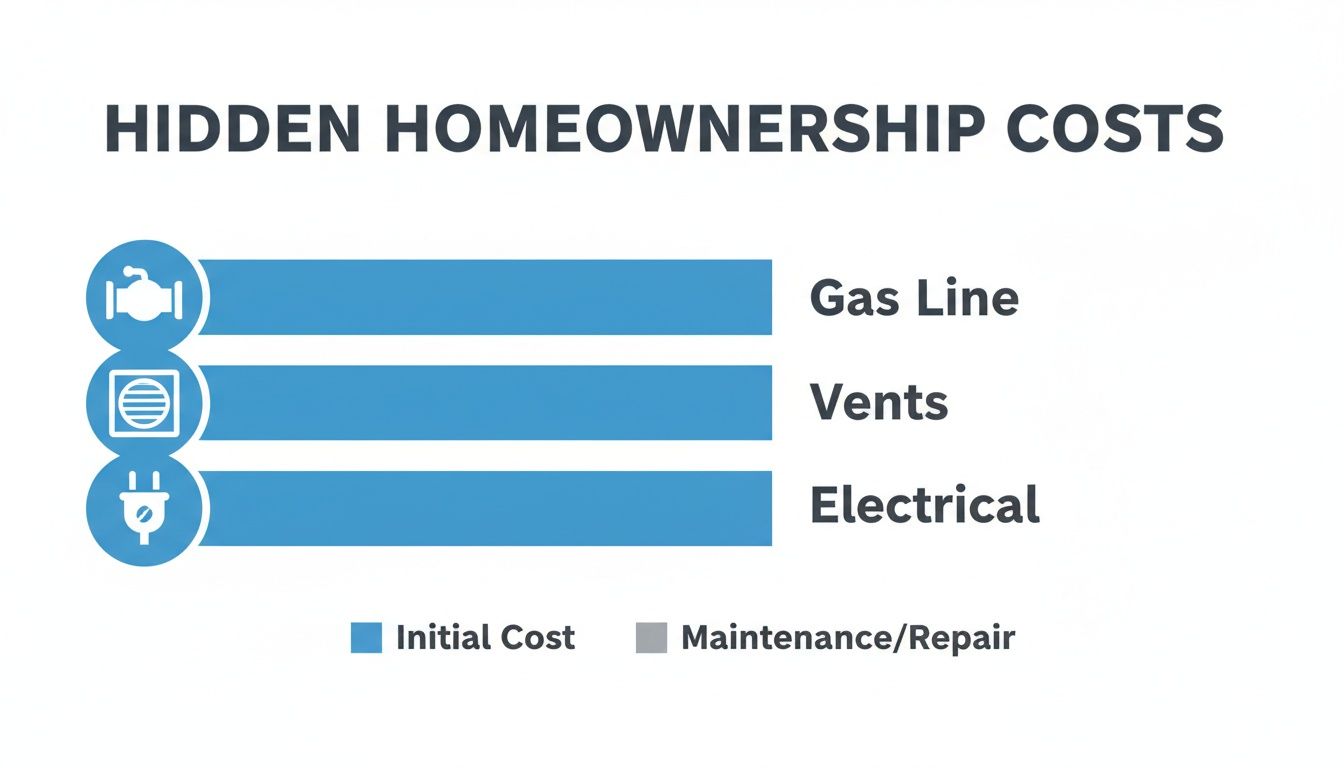
This illustrates how factors like gas line upgrades, proper venting, and electrical work are often part of the complete installation picture.
Tankless Water Heater Brand & Type Cost Comparison
To give you a clearer picture, here’s a look at how upfront installed costs and long-term operating expenses compare across different fuel types and popular brands you'll find here in Los Angeles.
Heater Type/Brand | Average Installed Cost | Annual Operating Cost (Est.) | Best For |
|---|---|---|---|
Premium Gas (Navien) | $5,999 - $10,500 | $250 - $350 | Larger homes with high hot water demand and homeowners prioritizing long-term efficiency savings. |
Standard Gas (Rinnai) | $4,500 - $8,000 | $300 - $400 | Medium to large homes seeking a balance of performance, reliability, and upfront cost. |
Budget Gas | $3,500 - $6,000 | $350 - $500 | Smaller homes or those with a stricter initial budget who still want the benefits of gas. |
Whole-Home Electric | $3,000 - $7,000 | $550 - $750+ | Homes where gas isn't an option or installations where venting is impossible. |
This table shows that while premium gas models have a higher initial price tag, their significantly lower annual operating costs can lead to substantial savings over the unit's lifespan.
What You Get with a Top-Tier Brand
So, what are you actually paying for when you choose a premium brand? It’s not just the name. These top-tier companies invest heavily in research and development, which results in real-world benefits for you.
Investing in a high-efficiency brand often means you're buying peace of mind. These units typically feature superior heat exchangers, more reliable components, and smarter diagnostics, leading to fewer service calls and a longer overall lifespan—often 20+ years with proper maintenance.
You also get superior performance. A high-end condensing unit can achieve an energy factor (EF) of 0.96 or higher, meaning it converts nearly all of its fuel into hot water. That efficiency directly reduces your monthly gas bill, helping you recoup the higher initial investment over time. This is a key factor when weighing tankless water heaters vs. traditional models.
A Look at Real-World Costs and Savings
The price difference between brands can be significant. Based on recent 2025 data, a premium tankless brand like Navien or Rinnai can run from $5,999 to $10,500 installed in a high-cost area like ours. Meanwhile, more basic models might be installed for $1,200 to $3,500. While that's a large gap, the long-term savings are where premium units make their case.
A tankless heater typically costs $250-$500 a year to run, compared to $500-$800 for a traditional tank heater. This means you can often recoup the extra investment in just 7-10 years. Here in Greater Los Angeles, about 60% of our 2024 installations have been Navien units. Homeowners love them for their powerful 199,000 BTU output, which is perfect for larger homes, and their ability to reduce gas usage by up to 34%.
Ultimately, picking the right brand and model is about finding the sweet spot between your budget, your family’s needs, and your long-term savings goals.
Calculating Your Long-Term Savings and ROI
The higher upfront cost of a tankless water heater can seem like a major hurdle. However, it's more accurate to view it as an investment in your home's efficiency. The real question isn't just about the initial price, but how long it takes for that investment to pay you back.
This is where understanding your return on investment (ROI) is crucial. When you look beyond the installation day, you'll see how a tankless system's long-term financial benefits create tangible value over time.
Slashing Energy Bills by Eliminating Standby Loss
The biggest source of savings from a tankless water heater comes from how it heats water. A traditional tank heater constantly burns energy to keep a large volume of water hot, even when you're not using it. This is called standby heat loss, and it's a significant source of wasted energy.
A tankless system, in contrast, only activates when you turn on a hot water tap. By heating water on demand, it completely eliminates standby loss, leading to substantial energy savings.
For a typical family, this efficiency translates directly into real dollars. Tankless units are often 24% to 34% more energy-efficient than their traditional tank counterparts. That reduction in energy use appears on your monthly utility bills, putting money back in your pocket.
By only heating water when you actually need it, a tankless system can save the average family over $100 per year on their gas bill. Over the 20-year lifespan of the unit, those savings can easily surpass the initial installation cost.
The Financial Benefit of a Longer Lifespan
Another huge piece of the ROI puzzle is the unit's lifespan. A well-maintained tankless water heater can last 20 years or more. That’s nearly double the typical 10 to 15-year lifespan you'd expect from a traditional tank heater.
This extended service life means you’ll be buying fewer water heaters over time. Instead of facing another major replacement cost in about a decade, your tankless system will still be operating efficiently for years to come. This longevity dramatically lowers your total cost of ownership.
Here’s a simple way to look at it:
Traditional Tank: Over a 20-year period, you're likely paying for a full replacement at least twice.
Tankless Unit: You pay for one installation that's built to last that entire time.
This longer replacement cycle is one of the key benefits of upgrading to a tankless water heater in Los Angeles that homeowners tell us they appreciate most.
Calculating Your Payback Period
So, how do you figure out your "payback period"—the time it takes for your savings to cover the initial cost? It’s a fairly straightforward calculation based on a few key numbers.
Find the Initial Cost Difference: Subtract the installed cost of a new traditional heater (e.g., $2,000) from the total cost of your tankless installation (e.g., $4,500). In this scenario, the difference is $2,500.
Estimate Annual Savings: Add up your yearly savings from energy efficiency, plus any one-time rebates or tax credits. Let's imagine you save $150 on energy and get a one-time $300 rebate.
Divide to Find the Payback Period: Divide the initial cost difference by your annual savings ($2,500 / $150 per year). The result gives you a rough estimate of how many years it will take for the unit to pay for itself.
While the initial investment is higher, the powerful combination of lower monthly bills, a much longer lifespan, and available incentives makes a tankless water heater an upgrade that truly pays you back.
Getting Your Questions Answered
Upgrading your home's plumbing always brings up questions. To help you feel confident in your decision, we’ve gathered answers to the most common things we hear from homeowners across Los Angeles about the real cost of a tankless water heater installed and the installation process.
Is a Tankless Water Heater Worth the Extra Cost in California?
For most homeowners in California, the answer is a definite yes. While the upfront cost is higher than a standard tank heater, the long-term savings on your energy bills add up significantly over time. It's an investment that pays for itself.
Furthermore, they have an impressive lifespan of 20+ years, meaning you avoid the cost and hassle of replacing a bulky tank heater every decade. When you add in the convenience of endless hot water and the extra storage space you gain, the value is clear.
How Long Does a Typical Installation Take?
The timeline really depends on the starting point, as every home is different.
Simple Swap-Out: If you're replacing an old tankless unit with a new one, the job is quite straightforward and can often be completed in 3 to 5 hours.
Standard Retrofit: The most common project—switching from a tank to a tankless system—usually takes a full day, typically between 6 to 10 hours. This allows time to handle any new plumbing, venting, or gas line adjustments properly.
A more complex job, like a retrofit in an older home that needs major upgrades to the gas lines, electrical, and venting, could easily extend into a second day. Your plumber will provide a clear, honest time estimate after an in-person assessment.
Do I Need a Permit to Install a Tankless Water Heater in Los Angeles?
Yes, absolutely. A permit is required for any new water heater installation throughout Los Angeles County and its surrounding cities. This is not just red tape; it's a critical safety measure to ensure the work is done to current building codes, protecting your home and family.
The good news is that a licensed, professional plumbing contractor will handle the entire permitting process for you. This includes applying for the permit and scheduling the final inspection with the city. You'll typically see this fee listed as a clear line item on your final quote.
How Do I Know What Size Unit My Home Needs?
Sizing the unit correctly is crucial for performance and depends on two main factors:
Flow Rate: This is the maximum amount of hot water you might use at once, measured in gallons per minute (GPM). To get a rough idea, add up the GPM of all fixtures you might run simultaneously. For example, a shower (2.5 GPM) and a dishwasher (1.5 GPM) would mean a 4.0 GPM demand.
Temperature Rise: This is how much the water needs to be heated from its starting temperature to your desired setting (usually around 120°F). In Los Angeles, our groundwater is relatively mild, so we don't need as significant a temperature rise as in colder climates.
A professional plumber can assess your home and water usage patterns to recommend the perfect size. This ensures you get reliable, endless hot water without overpaying for a unit that's more powerful than you need.
Ready to see how a tankless water heater could work for your Los Angeles home? The expert team at ZH Plumbing is here to give you a transparent, detailed quote and answer any other questions you have. Contact us today to schedule your free consultation.
Comments