

.png)

What Is a Tankless Water Heater and How Does It Work?
Running out of hot water halfway through a shower? Tired of paying high utility bills to keep a bulky tank of water heated 24/7? A tankless water heater solves these common frustrations by heating water the instant you need it, eliminating the wasted energy and limited supply of traditional tank models. Think of it as on-demand hot water, ready whenever you are.
This modern approach not only provides an endless stream of hot water but also significantly cuts down on the standby heat loss that can inflate your energy costs.
How a Tankless Water Heater Works
A tankless water heater, also known as an on-demand system, heats water directly without using a storage tank. When you turn on a hot water tap, cold water travels through a pipe into the unit. A powerful gas burner or an electric element fires up and heats the water as it passes through. The result is a constant supply of hot water delivered directly to your faucets without waiting for a storage tank to fill up.
This on-demand process is highly efficient. For most households, switching to a tankless model can lead to energy savings of 24% to 34%. If you use a lot of hot water, the savings can be even greater. For a deeper dive into the data, you can review the latest market research on tankless water heater efficiency.
The most celebrated benefit is the continuous flow of hot water—a true game-changer for large families or anyone who enjoys a long shower without it turning cold.
Tankless vs. Traditional Water Heaters at a Glance
To truly understand the difference, let's compare the two technologies side-by-side. This table highlights the key distinctions between on-demand and traditional storage tank water heaters.
Feature | Tankless Water Heater (On-Demand) | Traditional Water Heater (Storage Tank) |
|---|---|---|
Hot Water Supply | Endless and on-demand | Limited to the tank's capacity |
Energy Efficiency | Heats water only when needed, no standby loss | Constantly uses energy to keep stored water hot |
Operating Costs | Lower monthly utility bills | Higher due to standby heat loss |
Lifespan | 20+ years on average | 10-15 years on average |
Physical Size | Compact and wall-mounted | Large, bulky floor unit |
Upfront Cost | Higher initial investment | Lower initial investment |
While the initial cost is higher, the long-term benefits in energy savings, longevity, and convenience often make a tankless water heater a smarter investment.
The On-Demand Heating Process Explained
So, what exactly happens inside that compact box when you turn on the hot water? The technology is simple yet remarkably effective. It all begins the moment you open a hot water tap.
A Faucet is Turned On: A flow sensor inside the tankless unit detects the movement of water and signals the heater to activate.
The Burner Ignites: A powerful gas burner or electric element turns on, ready to heat the water instantly. There is no pilot light and no energy wasted keeping a tank hot.
Water is Heated: Cold water flows through a component called a heat exchanger, which consists of a series of super-heated coils. As water passes through, it absorbs heat and reaches your desired temperature in seconds.
A Faucet is Turned Off: The moment you turn off the tap, the flow sensor detects that the water has stopped, and the entire system shuts down, conserving energy until it's needed again.
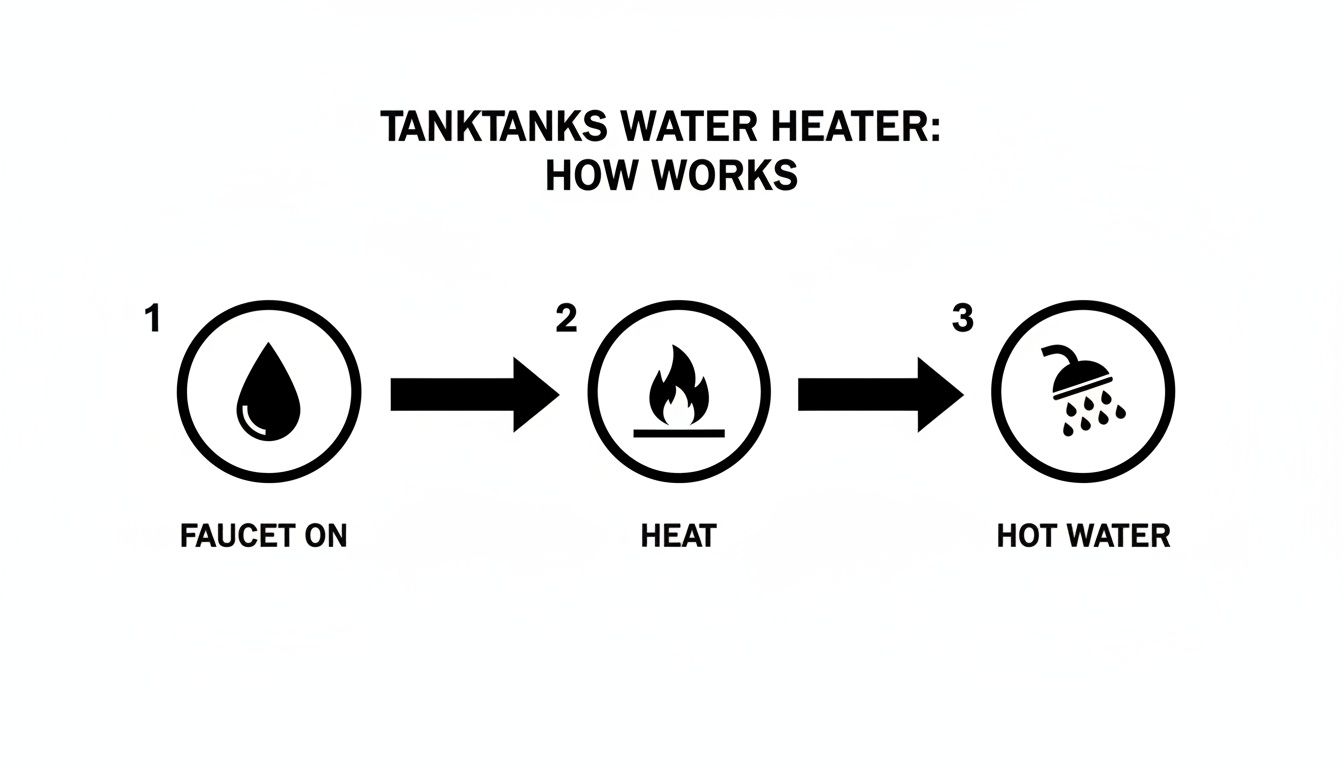
This direct-response cycle is the key to its efficiency and endless hot water supply.
Sizing Your Unit: Key Performance Factors
To ensure your tankless heater meets your needs, two factors are critical: flow rate and temperature rise.
Flow Rate (GPM): Measured in Gallons Per Minute (GPM), this tells you how much hot water the unit can produce at once. To determine your need, add up the GPM of all the fixtures you might run simultaneously (e.g., a shower and a dishwasher). A higher GPM is needed for larger households.
Temperature Rise: This is the difference between the incoming cold water temperature and your desired output temperature (typically 120°F). The heater must be powerful enough to bridge this gap, especially on colder days.
Proper sizing is essential for optimal performance. Additionally, for homes with hard water, exploring the benefits of a whole-house water filtration system can protect your investment and maintain efficiency.
The Pros and Cons of a Tankless Water Heater
While the technology is impressive, it's important to weigh the real-world advantages and disadvantages before making a decision. For many Los Angeles homeowners, the benefits align perfectly with a modern lifestyle, but there are potential hurdles to consider.
The Clear Advantages of Going Tankless
Beyond the continuous hot water, the benefits have a significant impact on your budget and home.
Energy and Cost Savings: By eliminating standby heat loss, tankless systems can reduce water heating costs by 30-50%. In a city with high utility rates, this can mean saving hundreds of dollars per year.
Longer Lifespan: A well-maintained tankless water heater can last 20 years or more—nearly double the lifespan of a typical storage tank heater. This makes it a superior long-term investment.
Space-Saving Design: Tankless units are compact—about the size of a small suitcase—and mount directly on the wall. This frees up valuable floor space in a closet or garage that a bulky tank would otherwise occupy.
Clean and Fresh Water: Because water is heated on demand, it isn't sitting in a tank where rust and sediment can accumulate over time.
Honest Drawbacks to Consider
No appliance is perfect. Here are the potential downsides to keep in mind.
Higher Upfront Cost: The initial investment for a tankless unit and its professional installation is significantly higher than a conventional tank heater.
Potential for System Upgrades: Many older homes require upgrades to support a tankless system. This can include enlarging the gas line for sufficient fuel flow or upgrading the electrical panel for an electric model. Our team can assess your needs with our gas line and leak detection services.
Slight Delivery Delay: You may notice a short delay (a few seconds) for hot water to arrive at the faucet, known as the "cold water sandwich." This is the time it takes for the unit to heat the water and push it through the pipes.
Across North America, the tankless market is growing as homeowners move away from inefficient tanks that waste energy 24/7. You can discover more insights about the tankless heater market to see the trend.
Weighing Your Options: A Quick Summary
Advantages (Pros) | Disadvantages (Cons) |
|---|---|
Lower monthly energy bills (30-50% savings) | Higher upfront installation cost |
Endless, on-demand hot water supply | May require gas line or electrical upgrades |
Lifespan of 20+ years (double a tank) | Slight delay for hot water delivery |
Compact, space-saving wall-mounted design | Requires professional installation & maintenance |
Ultimately, weighing these points will help you decide if the long-term benefits of efficiency and convenience are worth the initial investment for your home.
Choosing and Installing a Tankless Water Heater
Selecting the right tankless water heater is crucial for performance. Unlike a standard tank, one size does not fit all. An undersized unit will fail to provide enough hot water for simultaneous uses, while an oversized one is an unnecessary expense.
A professional plumber calculates your home's peak hot water demand by adding up the flow rates (GPM) of fixtures you might use at the same time. For example, a modern showerhead (2.0 GPM) and a dishwasher (1.5 GPM) running together require a unit that can handle at least 3.5 GPM.
The second part of the calculation is the temperature rise. Here in Greater Los Angeles, our groundwater is relatively warm (around 60-65°F), meaning the heater only needs to raise the temperature by about 50-60°F to reach a comfortable 120°F. This local advantage often allows for a smaller, more affordable unit compared to colder climates.
Why Professional Installation Is Non-Negotiable
While a DIY project might seem tempting, installing a tankless water heater is a complex task that requires a licensed professional. This is especially true in Los Angeles County, where strict safety codes and permits are enforced.
Venting Requirements: Gas models produce carbon monoxide and must be vented safely to the outdoors. Improper venting is a serious health hazard.
Gas Line Sizing: Most tankless units require a larger diameter gas line than traditional tanks. A professional must install natural gas lines safely and correctly to ensure adequate fuel supply.
Electrical Upgrades: High-powered electric models often need a dedicated circuit or even an electrical panel upgrade to handle the increased load.
LA-Specific Safety and Permit Requirements
In an earthquake-prone area like Los Angeles, safety codes often require an automatic gas shut-off valve. This device cuts gas flow during a significant seismic event, preventing potential fires or explosions.
Navigating city permits and ensuring your installation is fully compliant is a critical part of the job. Our team has years of experience handling professional tankless water heater installation across Los Angeles, managing everything from sizing and permits to the final inspection.
The True Cost and Long-Term Value

While the upfront cost of a tankless water heater is higher than a traditional tank, focusing solely on that number is shortsighted. The true financial story lies in the total cost of ownership and the long-term savings it generates.
Breaking Down the Initial Investment
The total upfront cost is a combination of several factors:
The Unit: The price of the heater itself, which varies by brand, size (GPM), and fuel type (gas or electric).
Professional Labor: The cost for a licensed plumber to install the unit, including mounting, connecting water and fuel lines, and ensuring it meets all codes.
System Upgrades: This is the most variable component. It can include costs for upsizing a gas line, installing new ventilation, or upgrading an electrical panel.
While the total is higher than a simple tank swap, this investment is the foundation for decades of efficiency.
Calculating Your Return on Investment (ROI)
A tankless water heater begins paying for itself from day one through lower monthly utility bills. By eliminating standby energy loss, you can achieve a full return on your investment within 5-7 years for a typical household.
Over its 20+ year lifespan, a tankless system can outlast two or even three traditional tank heaters. This longevity, combined with consistent energy savings, delivers substantial long-term value.
Furthermore, a tankless water heater is a valuable home upgrade that can increase property value. It's a key component of an energy-efficient home, complementing other energy-efficient home upgrades. Be sure to check for local utility rebates and federal tax credits that can help reduce the initial cost.
To make the upgrade more accessible, we offer flexible homeowner financing options.
Is a Tankless Water Heater Right for You?
Ultimately, the decision comes down to your priorities, budget, and long-term goals. If you're tired of running out of hot water, paying high energy bills, and replacing your water heater every decade, a tankless system is an excellent solution.
To help you decide, consider the following questions:
Does your household frequently run out of hot water? An on-demand system provides an endless supply, perfect for large families or homes with high-demand fixtures like soaking tubs.
Are you focused on long-term savings? If you plan to stay in your home for several years, the monthly energy savings can deliver a strong return on the initial investment.
Is space limited in your home? A compact, wall-mounted unit can free up valuable storage space in your garage, attic, or utility closet.
Is reducing your environmental impact important to you? Tankless heaters are more energy-efficient, which lowers your home's carbon footprint.
A tankless water heater is a long-term investment in your home's comfort and efficiency. By aligning the benefits with your family's needs, you can make a confident and informed decision.
A little routine maintenance, primarily annual descaling to remove mineral buildup from Southern California's hard water, is all that's needed to ensure your unit reaches its 20+ year lifespan.
If you're still unsure, a professional consultation can provide clarity. An expert can assess your home's plumbing, from your kitchen and bathroom fixtures to your main water line, and provide a tailored recommendation.
Frequently Asked Questions
Here are answers to some of the most common questions homeowners have about tankless water heaters.
How long does it take to get hot water with a tankless heater?
A tankless unit heats water almost instantly. The time it takes for that hot water to travel from the heater to your faucet is determined by your home's plumbing, which is typically the same delay you would experience with a tank heater. For true instant hot water, a recirculation system can be installed.
Will a tankless water heater ever run out of hot water?
No. As long as it has a supply of water and fuel (gas or electricity), a properly sized tankless water heater will provide a continuous, endless supply of hot water. This is one of its primary advantages over a storage tank, which is limited by its gallon capacity.
Do I need a special gas line for a tankless water heater?
Often, yes. Gas-powered tankless heaters require a higher volume of gas (measured in BTUs) than traditional tank models. Many homes, especially older ones in the Los Angeles area, have gas lines that are too small. A professional inspection is necessary to determine if your gas line needs to be upgraded to a larger diameter pipe.
Ready to explore if a tankless water heater is the right choice for your Los Angeles home? The team at ZH Plumbing provides expert inspections, professional installations, and clear, honest advice to help you make the best decision. Contact us today for a consultation.
Article created using Outrank
Comments