

.png)

How to Install a Hot Water Heater in Los Angeles: A Homeowner's Guide
That sudden blast of icy water during a shower is a rude awakening most Los Angeles homeowners dread. It's not just an uncomfortable surprise; it's a clear signal your water heater is failing. A broken unit means more than just cold showers—it can lead to surprise leaks, wasted energy, and utility bills that climb higher every month, a real concern for homeowners from the San Fernando Valley to the Westside.
Is Your Hot Water Heater Ready for Replacement?
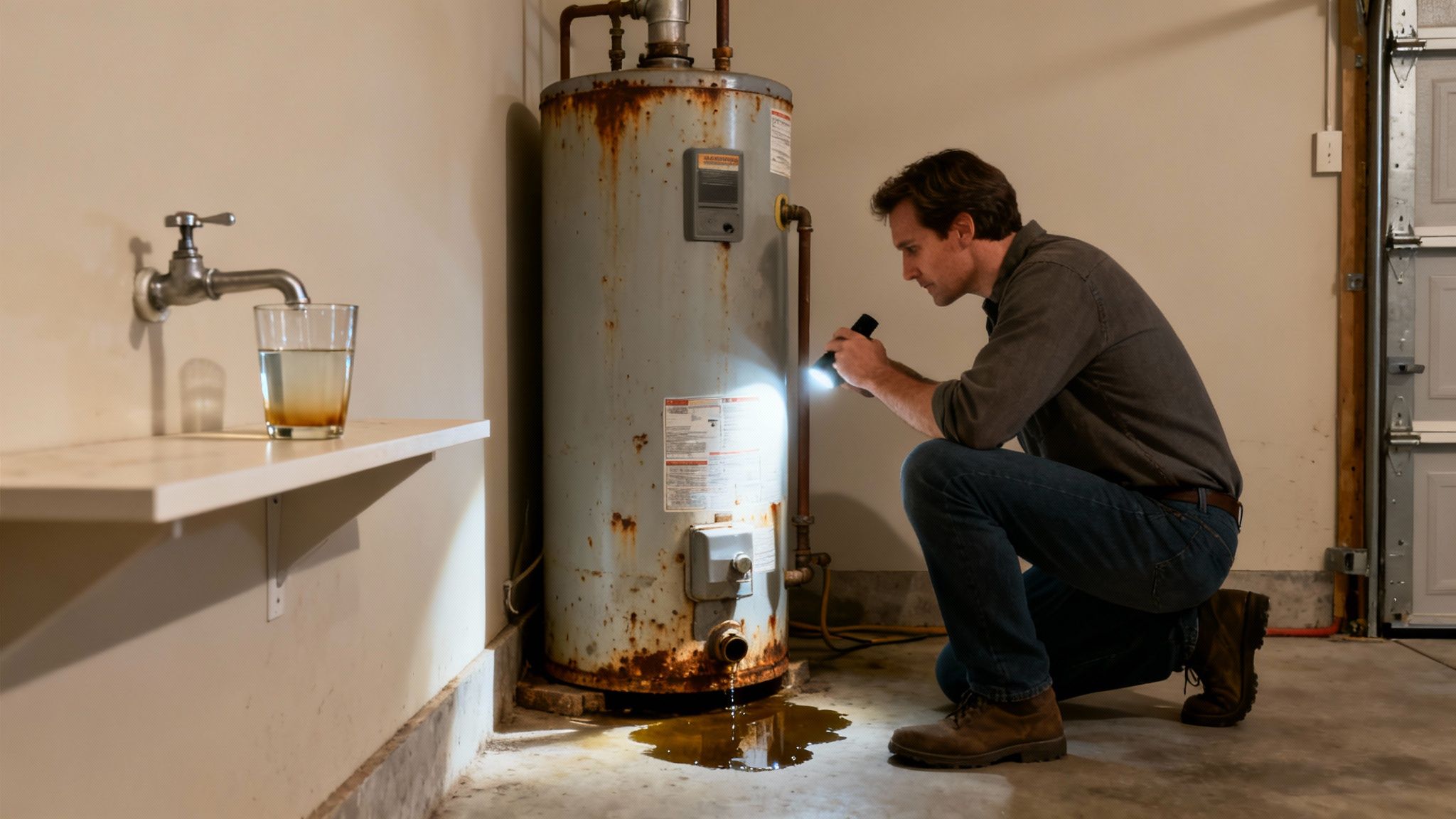
Before you jump into a project to install a hot water heater, it’s crucial to diagnose your current system’s health. The signs of failure are often subtle at first, creeping up long before the unit gives out completely. Catching them early can be the difference between a planned, stress-free replacement and a frantic emergency call on a Saturday night.
From Pasadena to Santa Monica, homeowners should keep an eye (and ear) out for a few classic symptoms. Water that’s only lukewarm is a big one. You might also notice your hot water supply dwindling fast, turning what used to be a long shower into a race against the clock.
Telltale Sounds and Sights
Beyond the temperature, your senses can tell you a lot. Are you hearing strange rumbling, popping, or banging noises from the tank? That's usually sediment buildup that has hardened at the bottom. This is a common problem with LA's notoriously hard water, and that layer of mineral gunk forces the heater to work overtime, killing its efficiency and setting the stage for tank failure.
Another dead giveaway is rusty or discolored water flowing from your hot water taps. This is a pretty clear sign that the inside of your tank is corroding and could be just one step away from springing a leak.
A proactive approach is always better than a reactive one. A small leak in the garage can quickly become a significant water damage claim, an expense and headache no Los Angeles homeowner wants.
The Age Factor and Hidden Costs
Most traditional tank water heaters are built to last about 8-12 years. If your unit is approaching that age or has already passed it, you're living on borrowed time. Even if it seems to be working, an older, inefficient model is likely costing you more than you realize on your monthly bills.
When you're sizing up your current system, think about these factors:
Rising Energy Bills: An aging heater has to burn more fuel to do the same job, which translates directly to a noticeable spike in your gas or electric bills.
Visible Leaks or Moisture: Any puddle of water around the base of the heater is a red alert. It means a replacement is needed immediately to prevent serious property damage.
Frequent Repairs: If you find yourself calling a plumber for repairs more than once a year, the math is simple. Those repair costs will quickly add up to more than the price of a new, reliable unit.
To get a better handle on your system's condition, a comprehensive guide like this Ultimate Rental Property Maintenance Checklist can be incredibly useful. For a more focused look at the warning signs, our blog post covering the 8 crucial signs you need a new water heater is a great resource.
Choosing the Right Water Heater for Your LA Home
Deciding to install a hot water heater is a major investment, and here in Los Angeles, the choice isn't always simple. Your decision should depend on your family's needs, whether you're in a sprawling single-family home in Glendale or a cozy condo in Hollywood.
The two main options are traditional storage tank heaters and modern tankless models. Each has unique pros and cons, and understanding them is key to getting a system that fits your home perfectly. It’s all about balancing upfront cost with long-term savings and daily convenience with energy use.
Traditional Tank Heaters: The Familiar Workhorse
When you picture a water heater, you're probably thinking of a storage tank model. It's that large, insulated cylinder that heats and holds a set amount of water—usually between 40 and 80 gallons—keeping it hot and ready 24/7.
Their biggest advantage? A lower initial installation cost and technology that’s simple and proven. For a smaller household or a rental property in Pasadena with predictable, moderate hot water needs, a well-sized tank heater is often the most practical, budget-friendly option.
But there’s a downside, and it’s called standby heat loss. Because the unit is always firing up to keep that large tank of water hot, it’s using energy even when you’re not using any hot water. Over time, that constant energy draw can lead to higher utility bills, a significant factor given California's energy costs.
Tankless Water Heaters: On-Demand Efficiency
Tankless water heaters, also known as on-demand heaters, are completely different. Instead of storing hot water, they use powerful gas burners or electric coils to heat water instantly as you need it.
This design delivers two huge benefits that resonate with many Los Angeles homeowners:
Endless Hot Water: Imagine this: a family in Santa Monica can run the dishwasher, do laundry, and have someone taking a long shower, all at the same time, without ever running out of hot water. If water is flowing, it's hot.
Superior Energy Efficiency: By only heating water when you turn on the tap, tankless units completely eliminate standby heat loss. They are often 24%–34% more efficient than traditional models, a fantastic way to lower your carbon footprint and your monthly bills.
The trade-off is a higher upfront cost for both the unit and the installation, which sometimes requires upgrading your home's gas lines or electrical panel. If you want to get into the details, check out our guide on what a tankless water heater is and how it works.
The industry is shifting toward greater efficiency. Market analysis shows the tankless water heater segment is projected to grow at a compound rate of about 6.5% annually through 2032. This growth is driven by energy-saving designs and on-demand performance, reflecting a larger trend toward sustainable home solutions.
Tank vs. Tankless Water Heaters: A Los Angeles Homeowner Comparison
So, which one is right for your home? It really comes down to what you prioritize—upfront cost or long-term savings, available space, and your family's hot water demand. Looking at them side-by-side can make the decision a lot clearer.
Feature | Storage Tank Water Heater | Tankless Water Heater |
|---|---|---|
Upfront Cost | Lower initial investment. | Higher initial investment. |
Energy Bills | Higher, due to constant heating (standby heat loss). | Lower, heats water only when you need it. |
Hot Water Supply | Limited to the tank's capacity. | Endless, as long as water is running. |
Lifespan | Typically 8-12 years. | Often lasts 20+ years. |
Space Required | Bulky, needs a good amount of floor space. | Compact and wall-mounted, saving valuable space. |
Best For | Smaller households, predictable usage, budget-conscious buyers. | Large families, high demand, long-term energy savings. |
Ultimately, choosing the best water heater isn't just about comparing two technologies on paper. It requires a real-world assessment of your home’s plumbing, gas lines, and electrical setup. An expert can size a unit correctly for your family, help you decide between gas and electric, and make sure your final choice delivers the best value for years to come.
Navigating Los Angeles Permits and California Safety Codes
When you decide to install a hot water heater in Los Angeles County, it’s not as simple as swapping out an old appliance. This is a job governed by a strict set of local and state regulations designed to keep your home and family safe. Ignoring these rules isn't just a bad idea—it can lead to failed inspections, a voided warranty, and serious safety hazards.
Your first step for most installations is pulling a permit. In the city of Los Angeles, that means going through the Los Angeles Department of Building and Safety (LADBS). A permit ensures the work is officially documented and inspected by a city official, who verifies that every part of the installation meets current safety standards.
This isn't just bureaucratic red tape; it's a critical quality-control check. It confirms that everything from the plumbing connections to the gas hookup is done correctly, protecting you from the risks of leaks, fires, or carbon monoxide exposure.
California-Specific Safety Mandates
Living in Southern California comes with unique risks, and our building codes are written to reflect that reality. When it comes to water heaters, there are several state-mandated safety features every homeowner needs to know about. These are not just suggestions—they are legal requirements for any new installation.
Here’s what’s non-negotiable:
Earthquake Straps: The California Plumbing Code demands that all tank-style water heaters are secured with at least two straps. One goes in the upper third of the tank, and the other in the lower third. This keeps the heavy unit from tipping over during an earthquake, which could easily rupture gas and water lines.
Temperature and Pressure (T&P) Relief Valve: Every tank water heater must have a T&P valve. It’s a small device that automatically releases water if the temperature or pressure inside the tank gets dangerously high, preventing a potential explosion.
Proper Venting: For any gas water heater, correct venting is an absolute must. The vent pipe must safely channel combustion byproducts like carbon monoxide completely outside your home. Improper venting is a silent but deadly hazard that you can't afford to get wrong.
The Automatic Gas Earthquake Shut-Off Valve
One of the most critical safety requirements for gas water heaters in our area is the automatic gas earthquake shut-off valve, often called a seismic valve. This device gets installed right on your main gas line and is designed to automatically stop the flow of gas to your entire home during an earthquake of a significant magnitude, typically 5.4 or higher.
This isn't just a "nice-to-have" feature; it's a life-saving device mandated by state law. A ruptured gas line after a major tremor is a primary cause of post-earthquake fires, and this valve is your first line of defense.
If you’re replacing an old gas water heater, the city inspector will check to make sure one of these valves is present and installed correctly. If your home doesn’t have one, you will be required to add it to pass inspection. To learn more, see our guide to earthquake gas shut-off valve installation and why it's so essential for homes across Los Angeles.
Understanding and sticking to these codes is crucial for a safe, successful installation. A licensed plumber will be fluent in all LADBS and California requirements, ensuring your project is completed correctly and passes inspection without a hitch.
What to Expect During Professional Installation
Deciding to install a hot water heater is a big step, but understanding what happens on installation day can give you peace of mind. While a DIY approach might seem tempting, the safety and code complexities—especially here in Los Angeles—make calling a pro the smartest and safest choice.
A licensed plumber follows a careful process to ensure the job is done right. It all begins with a thorough look at your current setup to make sure the transition to your new unit is smooth and safe.
The Initial Arrival and Site Preparation
When a licensed plumber arrives at your home in Glendale or Pasadena, their first priority is protecting your property. They will lay down protective coverings for your floors and clear a safe path to the work area, whether it's a garage, a utility closet, or the basement.
Next comes the critical safety shutdown of the old unit.
For gas heaters: The gas supply valve is turned off and the line is disconnected.
For electric heaters: The correct breaker in your home's electrical panel is switched off.
For both types: The main water supply feeding the heater is shut off to prevent any flooding.
Only after confirming all utilities are safely shut down does the removal of the old unit begin.
Safe Removal and Disposal of the Old Unit
Draining the old tank is the next step. A hose is connected to the drain valve, and all the water inside—often full of sediment and rust—is carefully emptied. This can take some time, especially for larger tanks.
Once empty, the old water heater is disconnected from the water lines, gas pipe, and venting. Your technician will then safely haul the bulky old unit out of your home. You don't have to worry about what to do with it; professional plumbers handle responsible removal and disposal as part of the service.
A crucial part of a professional installation is prepping the area for the new unit. We'll inspect the location, clean up any corrosion or debris, and make sure the new heater fits perfectly while meeting all clearance codes for safety and future maintenance.
The demand for reliable hot water installations is always growing. The global water heater market was valued at around USD 31.81 billion in 2025 and is projected to hit USD 46.34 billion by 2033. This consistent growth, detailed in these water heater market trends and findings, shows just how essential this appliance is to homeowners everywhere.
Installing the New Water Heater
With the old unit gone, the new water heater is carefully moved into position, ensuring it’s perfectly level and stable. For homes in active seismic zones like Los Angeles, this is where we install the state-mandated earthquake strapping, securing the tank firmly to wall studs to prevent it from tipping over during a tremor.
This is the non-negotiable, three-step safety process required by California code for any water heater installation.
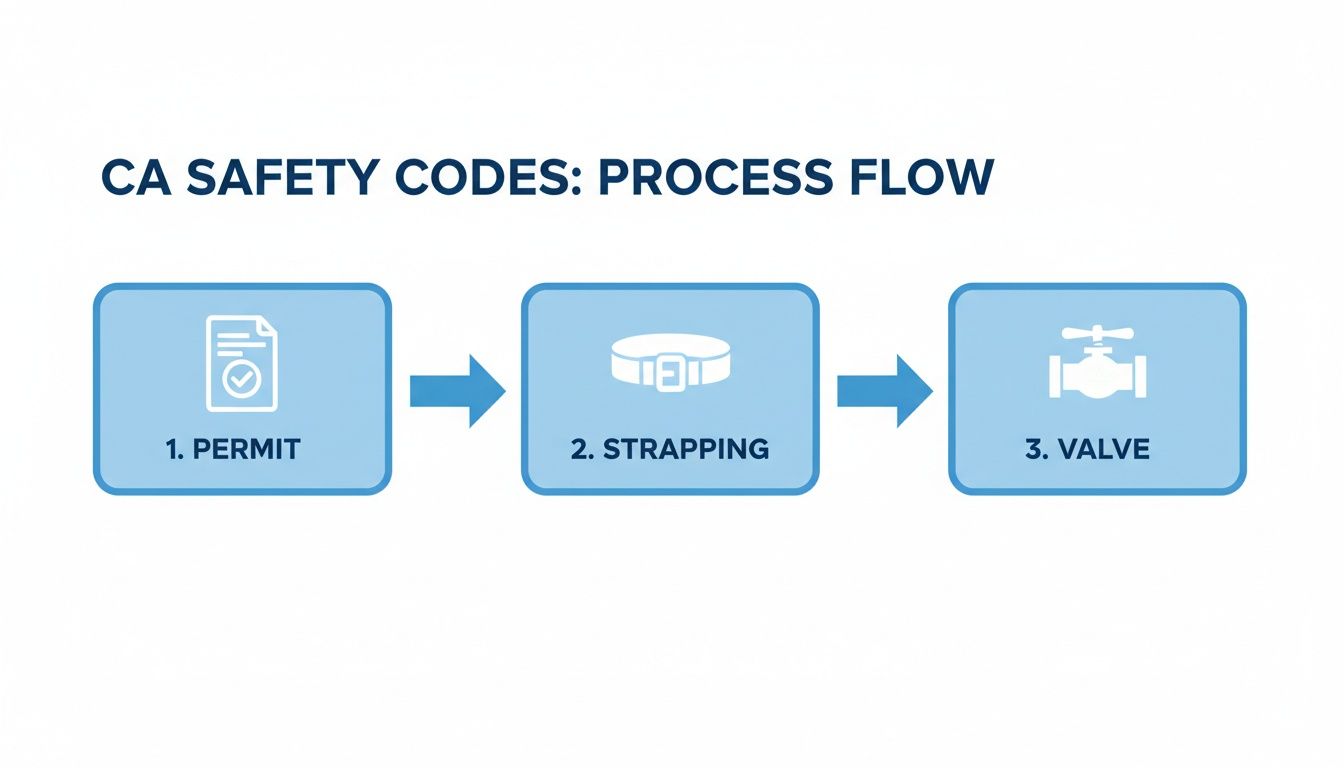
Securing the right permits, properly strapping the tank, and installing all the required safety valves are absolute musts for a safe, legal installation in our area.
Next, we tackle the plumbing connections. We use high-quality materials, like flexible copper or braided stainless steel connectors, to hook up the cold water inlet and hot water outlet. For gas models, we connect the gas line using the proper sealant and techniques, then run a thorough leak test with a specialized detector.
Final Commissioning and Safety Checks
The final stage is commissioning the system. We slowly fill the new tank with water, carefully bleeding all the air out of the plumbing lines by turning on a hot water faucet inside your house. This is a vital step to avoid damaging the heating elements.
Once the tank is full, we turn the power or gas back on and fire up the unit. Your plumber will check the thermostat, test the temperature and pressure (T&P) relief valve, and inspect every connection one last time for any sign of a water or gas leak.
We won’t leave until we've confirmed your new water heater is running safely, efficiently, and giving you the reliable hot water you count on. To see more about what's involved, check out our guide on water heater replacement services.
Why a Licensed Plumber Is Essential in Los Angeles
Tackling a hot water heater installation yourself might seem like a good way to save money, especially in an expensive area like Los Angeles. However, this is one job where a DIY approach can quickly turn into a costly and dangerous mistake.
An incorrectly installed gas line can create a slow, undetectable leak, posing a serious fire or explosion risk. Similarly, faulty wiring on an electric model can lead to short circuits and electrical fires. This isn't just about convenience; it’s about protecting your home and family.
The Hidden Costs of a DIY Installation
Beyond the immediate safety dangers, a DIY job can be expensive in the long run. First, nearly every water heater manufacturer will void its warranty unless the unit is installed by a licensed professional. If your new heater fails due to an installation error, you're on the hook for the full cost of repairs or replacement.
An improperly installed water heater is a leading cause of residential water damage. A single failed connection can lead to thousands of dollars in repairs to flooring, drywall, and personal belongings—a disaster easily avoided with professional expertise.
This is why understanding the value of hiring a licensed contractor is so important for any major home project. The principles of safety, code adherence, and protecting your investment apply across the board.
Navigating LA's Complex Code Requirements
Los Angeles County has some of the toughest building codes in the nation, and for good reason. Regulations around earthquake strapping and seismic gas shut-off valves are there to mitigate risks specific to Southern California. A licensed plumber doesn't just know these codes; they work with them every day and stay current on all local updates.
This professional expertise ensures your project goes smoothly:
Permits are handled correctly. We know when a permit is required and how to file the paperwork with the LADBS, saving you from legal headaches.
Inspections pass the first time. A pro installs everything to code, so you won’t face delays or rejections from a city inspector.
Safety is guaranteed. Every valve, strap, and connection is installed correctly, protecting your home from preventable disasters.
Hiring a professional gives you access to years of hands-on experience and peace of mind. To learn more about finding the right expert, our guide on how to choose the right plumber for your home has some great tips.
Common Questions About Water Heater Installation
Even after you decide it’s time to install a hot water heater, you're likely to have questions. It's a significant investment, and homeowners across Los Angeles want to know what they’re getting into. Here are the straightforward answers to the most common questions we hear.
What Does It Cost to Install a Water Heater in the Los Angeles Area?
The final price depends on the type of heater you choose and the complexity of the installation.
A straightforward replacement—swapping an old tank heater with a similar new one in the same location—is the most common job. For this, you can typically expect the cost to be somewhere between $1,200 and $2,500. That range usually covers the new unit, labor, materials, and necessary city permits.
Upgrading to a tankless system costs more, usually landing between $3,500 and $7,000. The higher price is because these installations are more involved. They often require running new plumbing, upgrading the gas line, or adding dedicated electrical circuits. We provide clear, upfront pricing to help you choose the best option for your home and budget.
How Long Does the Installation Usually Take?
The timeline depends on the job. A simple, like-for-like replacement of a traditional tank heater is fairly quick. You should plan on about 2 to 4 hours from start to finish.
Switching from a tank to a tankless water heater is a bigger project. This type of conversion usually takes around 6 to 8 hours. That extra time is for mounting the new unit, running new water and gas lines, and ensuring the venting is installed perfectly to code. We’ll always provide a realistic timeline before starting any work.
Is an Earthquake Shut-Off Valve Really Required in California?
Yes, absolutely. Both California state law and Los Angeles city building codes mandate an automatic gas shut-off valve (also known as a seismic valve) for any new or replacement gas water heater installation. It is a non-negotiable safety feature for our area.
How it works: This valve is installed on your main gas line. If it senses an earthquake of a certain magnitude—usually around 5.4 or higher—it automatically shuts off the flow of gas into your home.
Why it's crucial: In a major earthquake, broken gas lines are a primary cause of fires. This device is your best defense against a potentially catastrophic gas leak.
Our technicians ensure every gas appliance we install is fully compliant with this life-saving requirement.
What Maintenance Does My New Water Heater Need?
A little routine maintenance goes a long way in extending the life of your new water heater. For standard tank heaters, we highly recommend an annual flush. This simple task clears out the sediment and mineral buildup from LA's hard water, preventing corrosion and keeping the unit running efficiently.
For tankless heaters, periodic descaling is key. This should be done annually to prevent mineral scale from clogging the internal components and reducing performance. A simple maintenance plan can keep your new system running like new for years to come.
If you're ready to install a hot water heater or just want to explore your options, the licensed pros at ZH Plumbing are here to help. We provide expert installation and reliable service across the Greater Los Angeles area, from Pasadena to the surrounding communities.
Comments