

.png)

How to Fix a Leaking Faucet: A Guide for Los Angeles Homes
That constant drip... drip... drip... from a kitchen or bathroom faucet isn't just an annoying sound that keeps you up at night. For Los Angeles homeowners, it's a silent drain on your wallet and a waste of our precious water, one drop at a time. The good news is that most leaks are caused by a simple, worn-out part that you can often replace yourself without calling a plumber.
That Constant Drip Is Costing More Than You Think
That relentless dripping sound is the first sign of a problem that goes beyond simple irritation. For homeowners across Los Angeles, from the San Fernando Valley to the Westside, a leaking faucet is a steady stream of wasted money and resources. This is especially critical given Southern California's ongoing water conservation efforts. Every drop adds up, pushing your utility bills higher and putting an unnecessary strain on our local water supply.
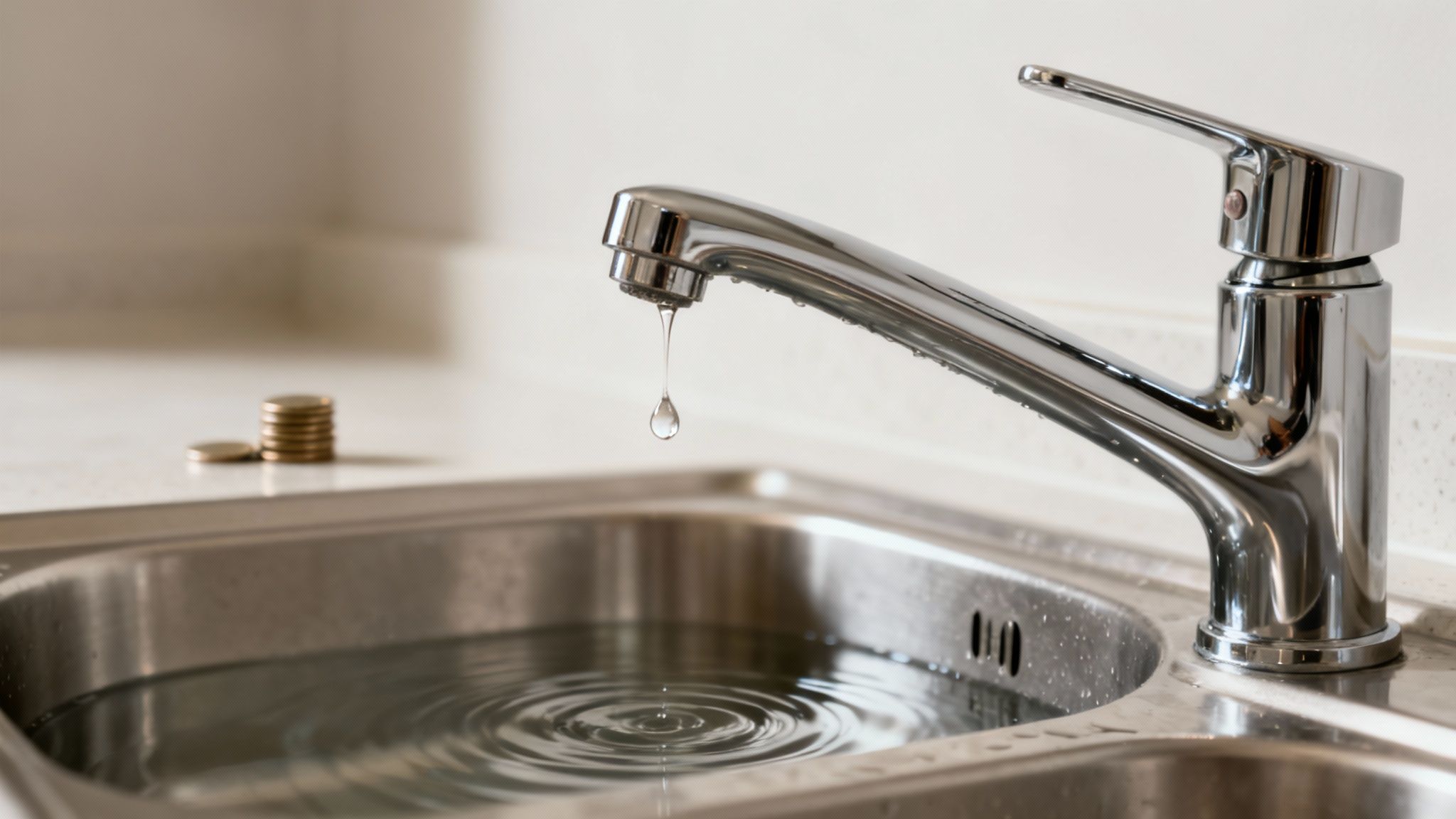
The True Cost of a Small Leak in LA
It's easy to ignore a small drip, but the numbers reveal a significant problem. A single faucet dripping once per second can waste over 3,000 gallons of water a year—enough to take more than 180 showers.
For the average Los Angeles household, fixing a common faucet leak can reduce your annual water bill by up to 10%. This simple repair isn't just about silencing a noise; it's a smart financial move that benefits your home and the community.
This type of waste is a major concern in the Greater Los Angeles area, where residents are all too familiar with drought conditions and water-saving measures. Statewide, those tiny drips from homes add up to billions in wasted water and energy costs annually.
Fixing that drip is a proactive step toward responsible homeownership. If you're curious about your household's consumption, our guide on how to read your water meter, a Los Angeles homeowner's quick guide can help. Understanding the bigger picture also highlights the value of timely repairs; you can discover more insights about plumbing industry trends on technavio.com.
Gathering Your Tools and Identifying Your Faucet
A successful faucet repair begins before you ever shut off the water. Rushing into the job without the right tools or a clear understanding of your faucet type is a recipe for frustration and multiple trips to the hardware store in Van Nuys or Culver City.
Taking a few minutes to get organized is the most important step. It transforms a potential headache into a smooth, satisfying DIY project. Think of it like cooking: you wouldn't start without having your ingredients and the recipe ready.
First, let's get your toolkit together. You don’t need a plumber’s entire van, just a few essential items for most common faucet repairs.
Adjustable Wrench: Your primary tool for loosening and tightening nuts on the faucet body and under the sink.
Screwdrivers: Have both a Phillips head and a flathead available.
Allen Wrench Set: Many modern single-handle faucets use a small, hidden set screw to secure the handle.
Plumber's Tape (Teflon Tape): Essential for creating a watertight seal on any threaded pipe connections you disconnect.
Rags or Small Towels: Needed for mopping up drips and protecting your sink's finish from scratches.
Flashlight or Headlamp: It’s always dark under a sink. Good lighting makes a world of difference.
Identifying Your Faucet Type
With your tools ready, the next critical step is to figure out what kind of faucet you have. The repair method and, more importantly, the replacement parts you'll need are completely different for each type. Most homes in the Los Angeles area have one of these four main kinds.
The most common mistake homeowners make is buying the wrong replacement parts. Identifying your faucet type first saves you time, money, and the frustration of a second trip to the hardware store.
Use this quick guide to identify what you’re working with.
Quick Guide to Faucet Types
This table will help you pinpoint your faucet type based on its handle operation. These are the models we see most often in homes around LA County.
Faucet Type | Handle Operation | Common Leak Source |
|---|---|---|
Compression | Two separate handles you tighten to shut off water | Worn-out rubber seat washers |
Cartridge | Single handle, moves up/down and side-to-side | The entire internal cartridge |
Ceramic Disc | Single lever, very smooth operation, often modern | Neoprene seals or the disc assembly |
Ball | Single handle moves over a rounded cap | Worn-out O-rings and cam seals |
Let's break down those types a bit further so you know exactly what you're looking at.
Compression Faucet: This is the traditional style with two separate handles for hot and cold, common in older homes. You have to tighten them to stop the water flow. If it’s dripping, 99% of the time it’s because the rubber washer inside has worn out.
Cartridge Faucet: Very common in newer homes, often with a single handle that moves up-and-down for pressure and side-to-side for temperature. These contain a movable plastic or brass cartridge. When they leak, you almost always just replace the entire cartridge.
Ceramic Disc Faucet: These are modern, high-end faucets known for being incredibly durable. They have a single lever that feels very smooth. Inside, two interlocking ceramic discs control the water. Leaks are rare, but when they happen, you usually replace the seals or the entire disc cylinder.
Ball Faucet: You’ll recognize this one by its single handle that pivots around on a rounded, ball-shaped cap. These were very popular in kitchens for years. Leaks here usually come from worn-out rubber O-rings and internal springs.
For a deeper dive into home plumbing maintenance, you can review some essential plumbing tips for Los Angeles homeowners.
Your Hands-On Guide to Fixing the Most Common Faucet Leaks
Alright, you have your tools and know what kind of faucet you're dealing with. It's time to get to work. Remember, fixing a leak isn't about brute force; it’s about a methodical approach to finding and replacing a small, worn-out part. Work patiently and wrap your wrench jaws with tape to protect your fixtures from scratches.
That constant drip... drip... drip is more than an annoyance. It can cost an average family $300 a year in wasted water. Across the U.S., household leaks waste nearly 1 trillion gallons annually, according to EPA data.
The good news? Most fixes involve simple steps: shut off the water, disassemble the handle, and replace a washer or cartridge. These parts usually cost less than $20 and solve 90% of leaks. At ZH Plumbing, our Los Angeles specialists often find these small issues during routine checks or larger installations, preventing bigger problems down the line.
This visual guide lays out the essential preparation. Gathering your tools and the correct replacement parts first will set you up for a smooth, successful repair.
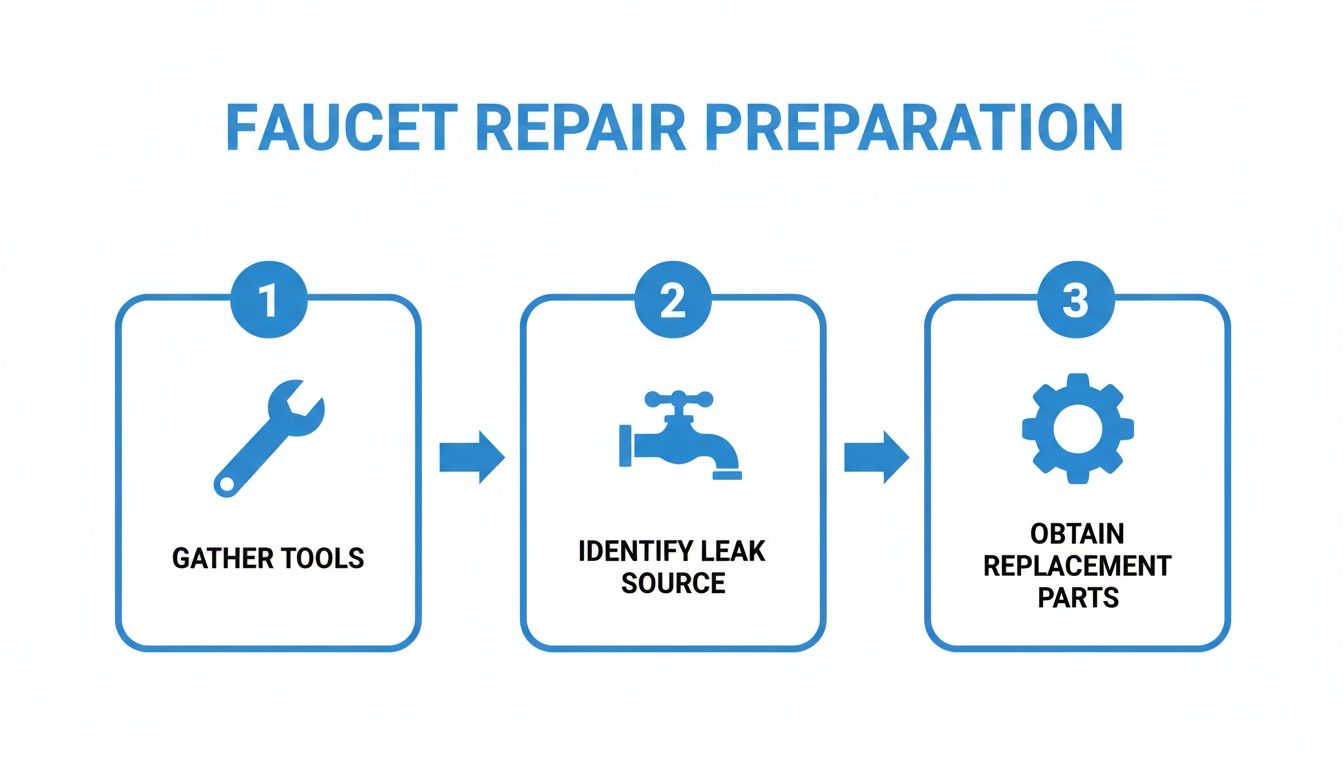
Following this sequence means you have everything you need on hand before you shut off the water, saving you frustrating mid-repair runs to the hardware store.
Fixing a Compression Faucet
Compression faucets, with two separate handles for hot and cold, are common in older Pasadena and Silver Lake homes. If you have a drip from the spout, a failed seat washer is almost certainly the culprit.
First, shut off the water using the valves under the sink. Then, open the faucet handles to drain any trapped water. Pry off the decorative cap on the handle and use a screwdriver to remove the screw underneath. The handle should pull straight off.
With the handle gone, use your adjustable wrench to loosen the packing nut, then unscrew the entire valve stem. At the bottom of that stem, you'll find the problem—a small rubber washer held by a brass screw. Replace this washer, reassemble everything in reverse order, and your drip should be gone.
Repairing a Cartridge Faucet
Single-handle cartridge faucets are incredibly common in modern kitchens and bathrooms across Los Angeles County. When these leak, the problem is almost always the entire internal cartridge.
After turning off the water, look for a small set screw, often hidden under a decorative cap on the handle. You'll likely need an Allen wrench to loosen it. With the screw loose, lift the handle off.
Next, you'll see a retaining clip or a nut holding the cartridge in place. Use pliers to pull the clip out or a wrench to remove the nut. Now, grip the top of the cartridge with pliers and pull it straight up. Mineral buildup from LA's hard water might make it stubborn; a little gentle wiggling usually frees it. Slide the new cartridge in, ensuring it's aligned correctly, and reassemble.
Pro Tip: Before you pull out the old cartridge, snap a quick photo with your phone. It’s a lifesaver for remembering the exact orientation when you install the new one, which is key for getting your hot and cold water to mix correctly.
Stopping Leaks in a Ball Faucet
Ball faucets have a single handle that pivots over a rounded, dome-shaped base. Inside, they use a system of O-rings, springs, and rubber seals. When one of these faucets leaks, it's usually because these small parts are worn out.
As always, start by shutting off the water. Loosen the set screw at the handle's base and lift it off. Now, use your wrench—with a cloth to protect the finish—to unscrew the cap and collar.
You'll see the plastic cam, washer, and metal ball. Lift them out. The leak is likely coming from underneath. Use needle-nose pliers to reach into the faucet body and pull out the two small inlet seals and their springs. Pop in the new ones, reinstall the ball and cam, and put the handle back on. Handling these fixtures is just one of the many services we provide for kitchen and bathroom plumbing throughout Los Angeles.
Sealing a Ceramic Disc Faucet
Ceramic disc faucets are built to last, but their neoprene seals can eventually wear out and cause a leak at the base.
Turn off the water and remove the handle, which is usually held by a single set screw. With the handle gone, you'll see an escutcheon cap. Unscrew it to expose the disc cylinder. Remove the screws holding the cylinder in place and lift it out.
At the bottom of the cylinder, you'll find several rubber seals. Carefully pry them out with a small flathead screwdriver and clean any sediment from the cylinder cavities. Press the new seals into place, reinstall the cylinder, and put your faucet back together.
For another perspective on tackling faucet repairs, you can explore other guides that offer additional tips on fixing a leaky faucet.
Troubleshooting Unexpected Repair Issues
You’ve followed the steps, replaced the part, and put everything back together. But when you turn the water on, that maddening drip… drip… drip… is still there. Don't give up—even experienced plumbers run into hiccups. Let’s walk through some common surprises you might face and how to solve them.
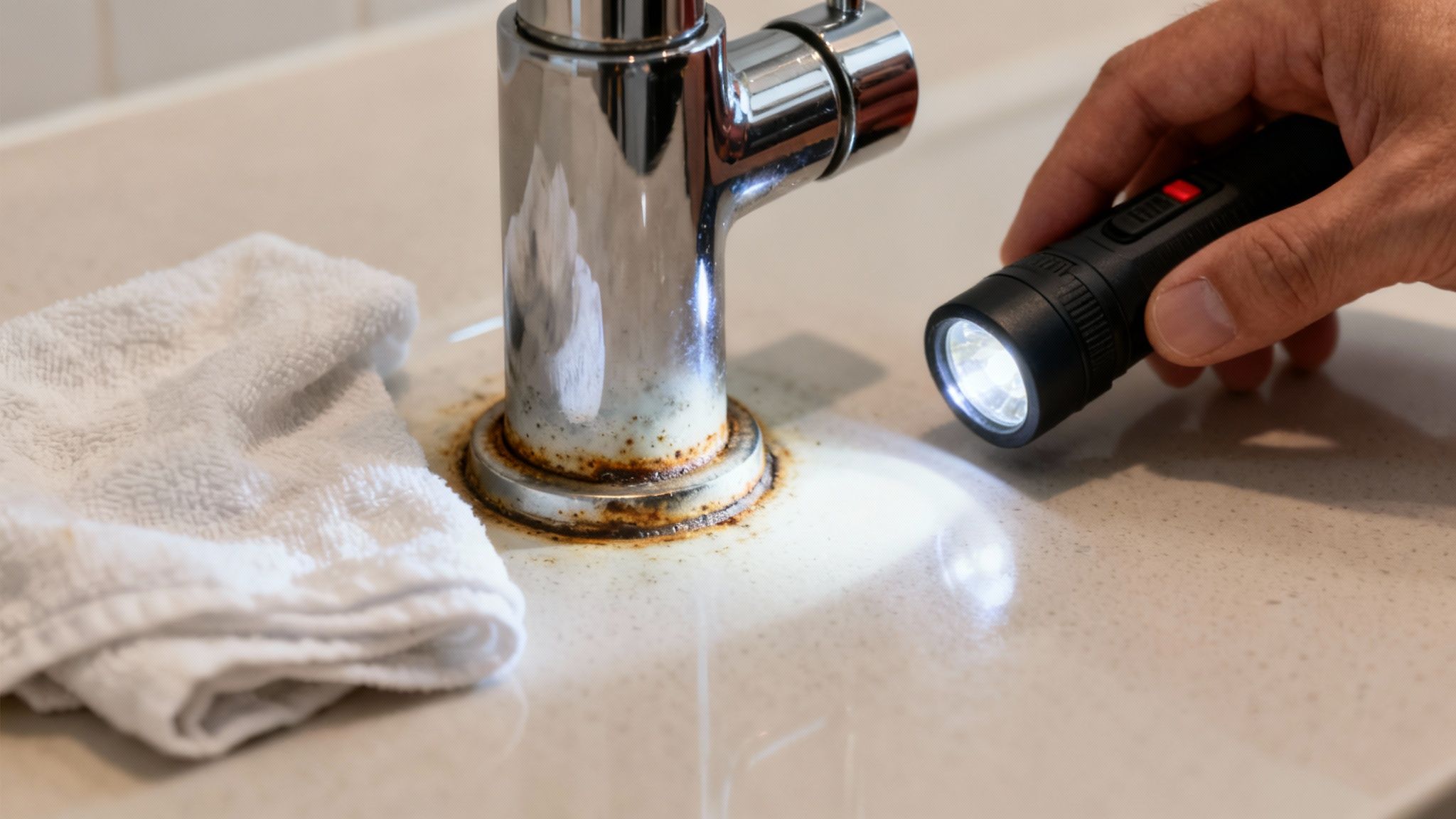
Sometimes, the leak isn't coming from where you think. A leak at the faucet's base points to a different culprit than a spout drip. This usually means the O-rings that seal the spout to the main body have failed. To fix this, you’ll need to lift the entire spout off to access them.
Dealing With LA's Hard Water
Here in Los Angeles, our water is notoriously hard, packed with minerals like calcium and magnesium. This buildup, known as limescale, can cause parts to seize up, making them difficult to remove. It can also prevent new seals from seating correctly.
If a part won’t budge, resist the urge to use force. Instead, soak a rag in white vinegar and wrap it around the stubborn part for an hour. The acid in the vinegar will help dissolve the mineral deposits, often making removal much easier.
Pro Tip: When disassembling a faucet, lay out the pieces in the exact order you removed them. Better yet, snap photos with your phone at each stage. This creates a simple visual roadmap for reassembly and prevents a major headache later.
What to Do If the Drip Just Won't Quit
If you've replaced the main part—like a washer or cartridge—but the faucet still drips, the problem might be the valve seat. This is the small metal ring that the washer presses against to stop water flow. Over time, it can become corroded or pitted, preventing a perfect seal no matter how new the washer is.
You can sometimes smooth it out with a special tool called a valve seat dresser, but the best long-term solution is usually to replace it. A persistent drip after a repair is a clear sign of a deeper issue. For more help tracking down tricky problems, you can learn how to detect water leaks with our Los Angeles homeowner's guide.
A Final Tip: Protect Your Fixtures
Here’s one last piece of advice from our 20 years serving the LA area: always protect your faucet's finish. It is incredibly easy to scratch chrome or brushed nickel with a metal wrench.
You can avoid this by:
Wrapping the jaws of your wrench with a layer or two of electrical tape.
Placing a soft cloth between the wrench and the fixture.
This simple step takes seconds but keeps your faucet looking brand new, ensuring your successful repair doesn't leave behind an ugly, permanent mark.
Knowing When to Call a Professional Plumber in Los Angeles
Fixing a leaky faucet yourself can be incredibly satisfying. But a savvy homeowner knows when to put down the tools and call a professional. Sometimes, that simple drip is a symptom of a deeper problem that a new washer won't fix.
Spotting these red flags early can stop a minor issue from turning into a major plumbing emergency.
If you’ve already tried a repair once or twice and the leak stubbornly returns, it’s time to stop. A persistent drip often points to a pitted valve seat or a tiny crack in the faucet's internal body. These issues require specialized tools and a professional's touch. Continuing to try could damage the fixture beyond repair.
Signs of a Deeper Problem
Here are a few clear warning signs that your faucet issue is beyond a basic DIY job. We see these frequently in homes across Los Angeles, from Santa Monica to the Valley.
Visible Rust or Corrosion: Significant rust on the pipes or connections under the sink indicates a long-term moisture problem that could be weakening your supply lines.
New Issues Appear: Did your repair attempt create new problems, like a sudden drop in water pressure or strange noises? You may have accidentally dislodged sediment or damaged another component.
The Leak Is at the Base: While a leak at the faucet's base can sometimes be a worn O-ring, it can also signal that the faucet's core housing has failed, which is often not a repairable part.
Unchecked faucet leaks are a surprisingly serious problem, contributing to 14% of all household water waste globally. Here in earthquake-prone Southern California, ground vibrations can trigger 35% more leaks, making professional expertise even more critical. Understanding these risks is why countless homeowners trust ZH Plumbing's 24/7 response to prevent minor drips from turning into major floods.
Choosing the right expert is key. To help you make an informed decision, check out our guide on how to choose the right plumbing professional for your home. If your faucet issue does require professional help, knowing how to find qualified plumbers through effective local SEO for plumbers can make the process much easier.
Got Questions About Your Faucet Fix? We’ve Got Answers.
Even after you've tightened the last screw, a few questions might remain. Here are quick, straightforward answers to what we hear most often from Los Angeles homeowners who have just tackled a leaky faucet.
What is the most common cause of a leaky faucet?
Nine times out of ten, the drip is caused by a small, worn-out part inside the faucet. For an older, two-handle compression faucet, the problem is almost always a bad rubber washer. For modern single-handle faucets, a worn O-ring or a failing cartridge is the usual suspect. These components are under constant stress, and in Los Angeles, our hard water can cause them to wear out even faster.
What should I expect to pay a plumber to fix a leak in Los Angeles?
If a DIY fix isn't possible, you'll need to call a professional. In the LA area, a plumber typically charges between $150 and $350 to fix a standard leaky faucet.
This price can vary based on:
The faucet type: A simple compression faucet is a quicker and cheaper fix than a complex ceramic disc model.
The parts needed: Some proprietary replacement cartridges can be more expensive than a simple washer.
Job complexity: If old parts are corroded and fused, it will take more time and effort to remove them.
At ZH Plumbing, we believe in transparency. We provide clear, upfront pricing before we begin any work, so you'll never face a surprise on your bill.
Can I just tighten the handle to stop the drip?
Resist the urge! Overtightening a faucet handle will not solve the leak and is a surefire way to cause bigger problems. The drip comes from a failed internal seal, not a loose handle.
Forcing the handle can strip the gears or crack the valve seat—the metal part the washer seals against. This can turn a simple, inexpensive parts swap into a full faucet replacement.
How long should a faucet last?
A good quality faucet can easily last 15 to 20 years, but the small internal parts that do the work have a much shorter lifespan. Think of them like tires on a car—they are designed to wear out and be replaced. You can expect to change washers, O-rings, and cartridges every 3 to 10 years, and even sooner in Los Angeles neighborhoods where hard water is common.
If that drip just won't quit, or if you'd rather leave the job to the pros, don't hesitate to give us a call. The experts at ZH Plumbing are on standby 24/7 to deliver fast, reliable solutions for any plumbing headache in the Los Angeles area. Contact us today for professional faucet repair in the Greater Los Angeles area.
Comments