

.png)

How to Read Your Water Meter: A Los Angeles Homeowner's Quick Guide
Is your latest water bill from LADWP shockingly high? If you're a homeowner in Los Angeles or the surrounding areas, that feeling of dread when you see an unexpected spike in your utility costs is all too common. Before you blame the sprinklers or start rationing showers, the real answer might be hiding in a small box at the curb.
Learning how to read your water meter is one of the most powerful skills you can have as an LA homeowner. It empowers you to verify your bill, catch costly leaks before they cause major damage, and gain control over your home's water consumption, especially with our local tiered water rates.
Why You Should Be Reading Your Water Meter
Think of your water meter not as the utility company's property, but as your home's personal water dashboard. Here in Southern California, where water conservation is a constant concern, understanding what that little dial says is essential. A quick look can reveal a lot about your home's plumbing health.
Instead of passively accepting your monthly charges, this simple skill puts you in control of managing one of your home's most vital—and expensive—resources.
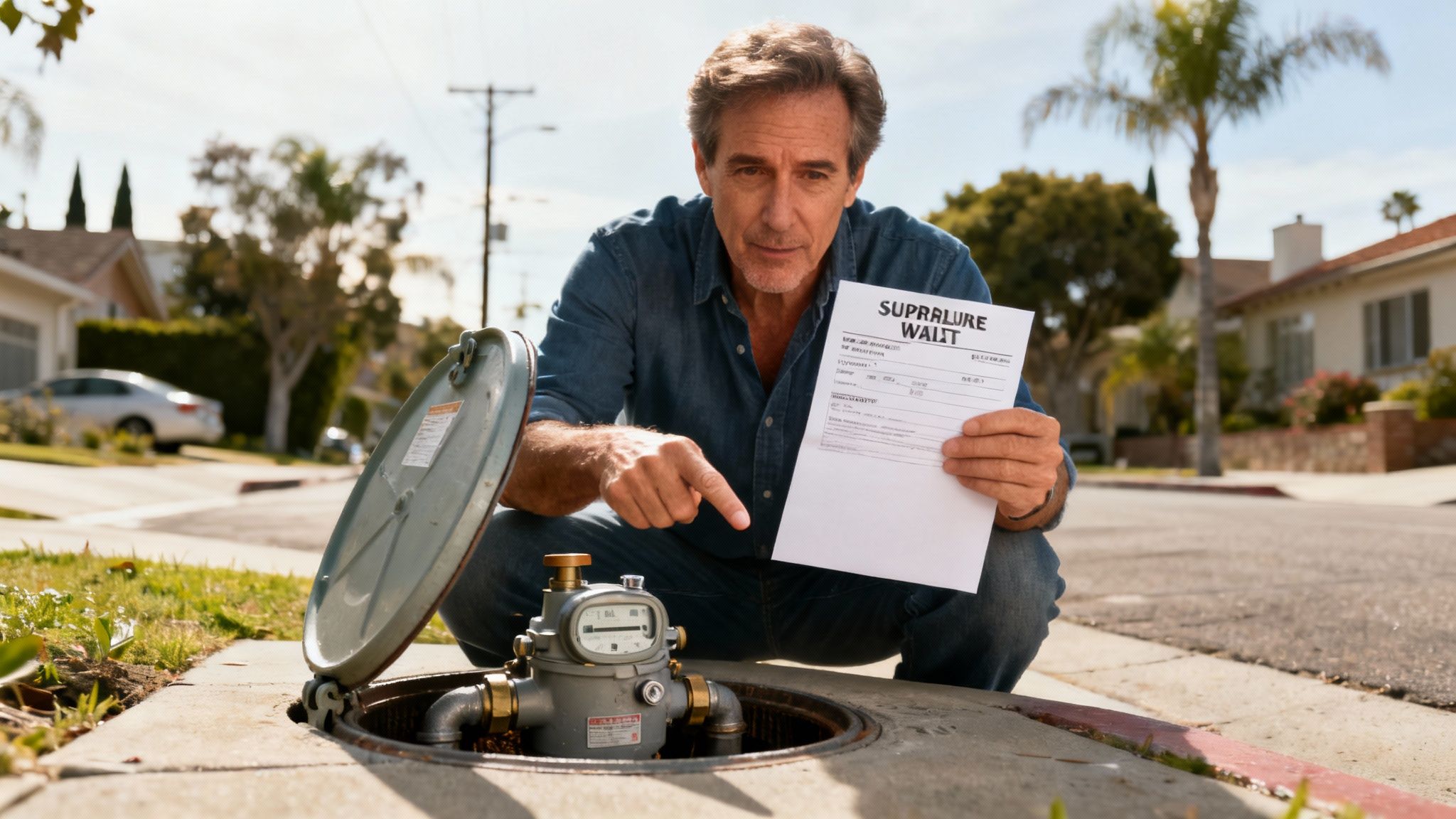
Take Control of Your Water Bill
When you regularly check your water meter, you start to see the unique consumption patterns of your household. That knowledge is power, allowing you to make smart, targeted changes that lead to lower bills.
Here’s what you gain:
Verify Your Bill: Does the usage on your LADWP bill seem right? Compare it to your meter's actual reading. Catching a billing error early can save you a significant headache.
Become a Leak Detective: The small low-flow indicator on your meter is your best tool for finding hidden leaks. It can alert you to problems long before you see water damage, saving you from costly repairs.
See Savings in Real-Time: Curious if those new drought-tolerant plants or water-efficient fixtures are making a difference? Your meter provides immediate feedback on your conservation efforts.
Provide Key Info to Your Plumber: When you call a plumber in the LA area, providing real data on your water usage helps them diagnose the problem much faster.
Water meters are the "cash registers" for the utility, yet most homeowners were never taught how to read them. Shockingly, water utilities can see non-revenue water losses of 20–30% from leaks or inaccurate meters. This means nearly one in every three gallons pumped might not be properly billed.
A Plumber’s Best Friend
When we get a call from a homeowner in the Los Angeles area, having recent meter readings is a game-changer. For example, if you can tell a technician that your usage suddenly jumped from 8,000 to 16,000 gallons in a single month, you've given them a massive clue to start with.
This kind of information cuts right to the chase, helping us pinpoint the problem much faster. To see why this is so valuable, check out our guide on the importance of plumbing inspection services. A little bit of homework on your end can easily reduce our time on-site, which often means a lower service cost for you.
How to Find and Safely Access Your Water Meter in Los Angeles
Before you can read your meter, you have to find it. Thankfully, in most Los Angeles neighborhoods from the Valley to the Westside, this is straightforward. Your meter is typically located inside a concrete or plastic box set into the ground near the curb at the front of your property.
Look for a lid stamped with "WATER" or the initials of your local utility, like "LADWP." You'll usually find it in the parkway—the strip of grass between the sidewalk and the street. Don't be surprised if it's covered by overgrown grass or landscaping; you might need to look carefully.
Opening the Meter Box Lid
Once you've located the box, you'll need to open it. Many modern lids have a simple lock that can be opened with a large flathead screwdriver or a special meter key. Insert the tool into the slot, give it a quarter-turn, and carefully lift the lid. Be aware that these lids can be heavy.
Be prepared for what you might find inside. It's common to see:
Debris: Dirt, leaves, and small rocks almost always accumulate.
Critters: Spiders and other insects often make their homes in these dark, protected spaces.
Water: Some standing water is normal after rain, but if it's there on a dry day, it could signal a leak near the meter.
Quick tip: Always wear gloves before reaching into the meter box. Use a small brush or a garden trowel to clear away any debris covering the meter's face. This keeps your hands safe and ensures you can see the dial clearly.
If you can't find the meter box or if it seems buried under dirt or concrete, your first step should be to call your water utility. They have maps of their service lines and can help pinpoint its exact location. A plumber generally only needs to get involved for issues on your side of the meter, like a problem with your main shut-off valve. Knowing the cost to install a water shut-off valve can be useful if you discover access problems related to your home's own plumbing.
Decoding the Different Types of Water Meters
Once the lid is off, the next step is to identify what kind of meter you're looking at. Not all meters are the same; your home could have different types depending on whether it's in a historic Pasadena neighborhood or a newer development in Santa Monica.
Knowing your meter's display type is the key to getting an accurate reading. This visual guide is a great reminder of where to start your search before we dive into the specifics.
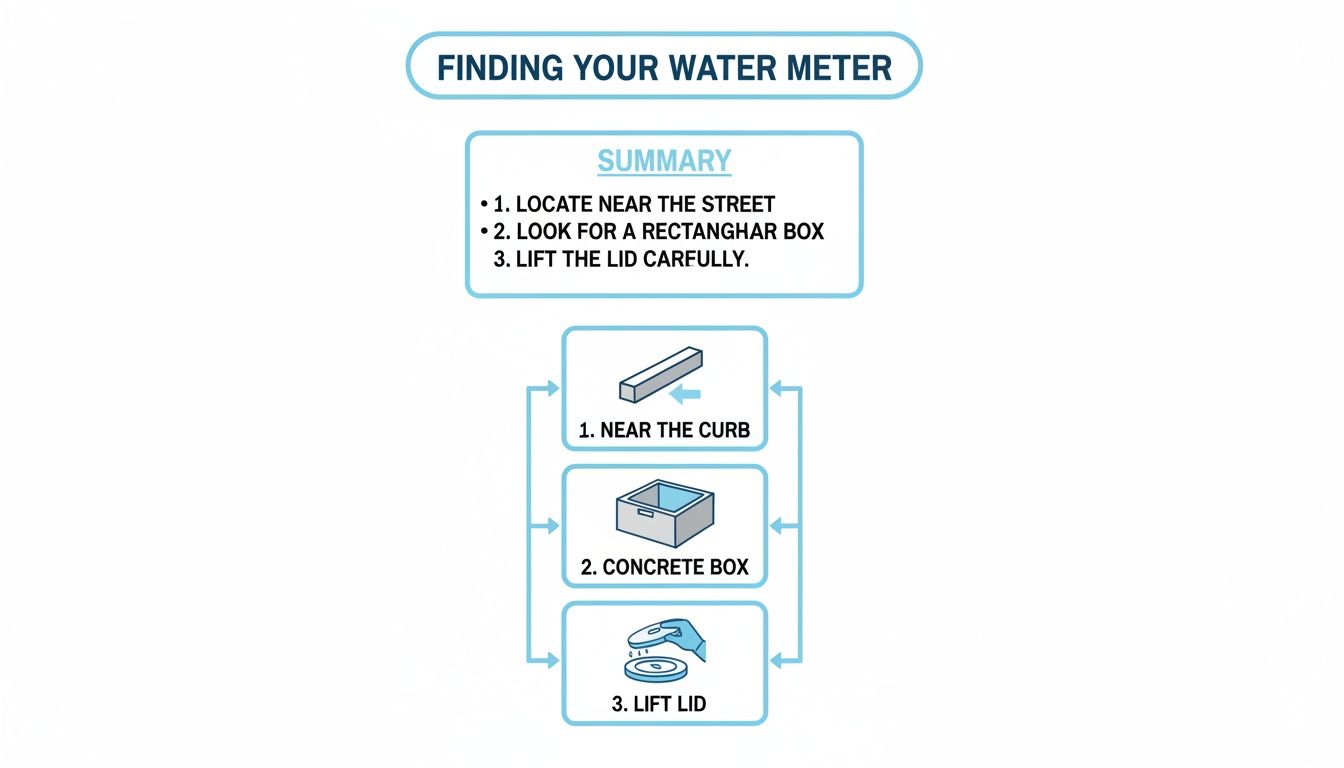
As you can see, it's usually a simple process: find the box near the curb, carefully lift the lid, and clear away any dirt to get a good look at the meter's face.
So, what kind of meter are you looking at? Most meters in the Greater Los Angeles area fall into one of three categories.
This quick table can help you identify your meter at a glance and understand how to read its display.
Identifying Your Water Meter Type | |||
|---|---|---|---|
Meter Type | Appearance | How to Read It | Common Units |
Analog Straight-Reading | Looks like a car's odometer with a row of numbers. | Read the numbers from left to right, ignoring the last one or two digits (often a different color). | Cubic Feet (CF) or Gallons (GAL) |
Analog Dial | Features multiple small, clock-like dials. | Read the dials clockwise, starting with the highest value. Always record the lower number if the pointer is between two digits. | Cubic Feet (CF) or Gallons (GAL) |
Digital Meter | An LCD screen that displays numbers electronically. | Shine a light on the solar sensor to activate the display. Record the main consumption number that appears. | Gallons (GAL) or Cubic Feet (CF) |
Each type has its own quirks, but with a little practice, you'll be able to read any of them like a pro. Let's break down exactly what you need to know for each one.
Analog Straight-Reading Meters
This is the most common type you'll find around Los Angeles. It looks much like a car's odometer—a single, straight line of numbers.
To read it, simply write down the numbers from left to right. Your utility bill will usually indicate which digits to ignore; typically, it's the last one or two on the far right, which might be a different color. These digits track smaller increments and are great for leak detection but aren't used for billing.
Analog Dial Meters
If you live in an older Los Angeles home, perhaps in areas like Glendale or Beverly Hills, you might have a meter with a series of small, clock-like dials. They can seem intimidating, but they're easy to read once you understand the rules.
Go Clockwise: Start with the dial marked "100,000" and read each dial in order, moving clockwise down to the one marked "10."
Take the Lower Number: If a pointer is between two numbers (say, a 7 and an 8), you always record the lower of the two. In this case, you'd write down 7.
The Tricky "9" Rule: Here's the part that trips people up. If a pointer is between a 9 and a 0, you write down 9. But before moving on, you must look at the dial immediately to its right. If that next dial hasn't passed 0 yet, you need to reduce your reading for the first dial by one (so the 9 becomes an 8).
This "9" rule is where most reading errors happen. It’s absolutely crucial to read the dials in the correct sequence and double-check the pointer's exact position before jotting down the number.
Digital Meters
Newer homes and recently upgraded water systems often feature digital meters. These are the easiest to read, as they display the numbers on an LCD screen, removing any guesswork.
You might need to activate the display by shining a bright flashlight on a small solar sensor or simply by opening the meter box lid. The screen will then cycle through readings, showing your total water consumption and sometimes the current flow rate. All you have to do is write down the main consumption number.
No matter your meter type, look for the low-flow indicator. It's a tiny red or blue triangle, a star, or a small sweep hand that spins with even the slightest water movement. If every faucet, toilet, and appliance in your house is off but that little indicator is still turning, that’s the tell-tale sign of a leak.
If you spot a spinning indicator and suspect a hidden leak, figuring out the source can be tough. Our guide on how to find reliable help for your plumbing needs offers practical advice on what to do next.
Using Your Meter to Find Hidden Water Leaks
Your water meter is more than just a billing tool; it's your first line of defense against sneaky, expensive water leaks. A high bill is often the first red flag, but your meter provides a definitive answer long before you see water damage.
Performing a leak test is a simple process any Los Angeles homeowner can do. You don't need special tools—just a few minutes and a keen eye. This quick check can save you hundreds on your water bill and prevent thousands in property damage.
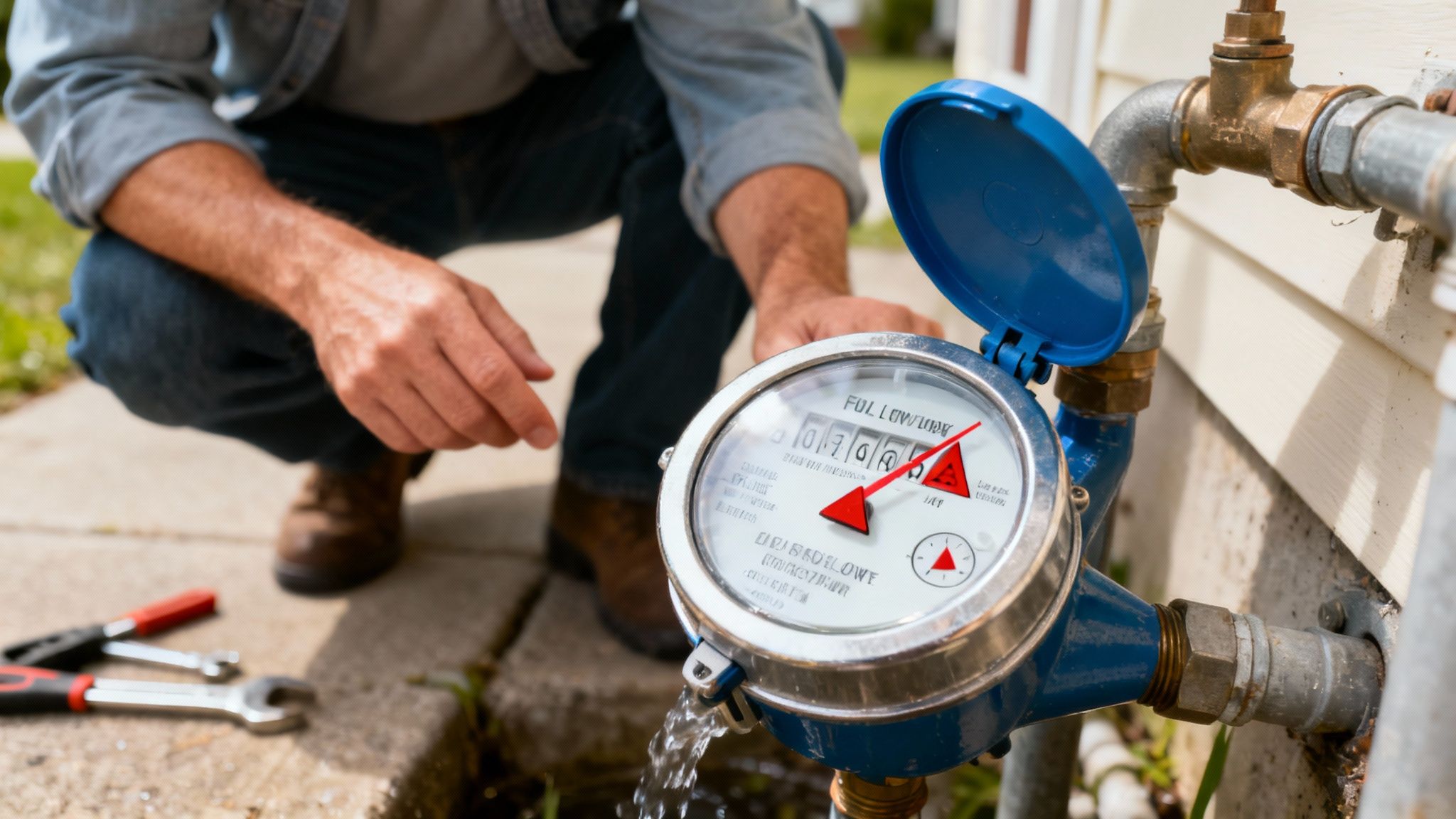
Performing a Simple Home Leak Test
The goal is to create a period of zero water use and see if your meter still records any activity. It's that simple.
First, make sure every single water-using appliance in and around your home is turned off. This is the most crucial step for an accurate test.
Go through this checklist:
All faucets (kitchen, bathrooms, utility sinks)
Toilets (listen to ensure none are running)
Dishwasher and washing machine
Ice makers
Sprinklers and irrigation systems (shut them down at the controller)
Outdoor hoses and spigots
Once you're positive nothing is running, go to your meter. Write down the exact reading, or note the precise position of the sweep hand. Pay close attention to the low-flow indicator—the small triangle or star that spins with even the slightest water flow.
Now, wait for 30 to 60 minutes. During this time, no one in the house should use any water. No flushing toilets, no washing hands, nothing. After the time is up, go back and check the meter again.
Interpreting the Results of Your Test
If the meter reading hasn't changed and the low-flow indicator is still, you can relax. You most likely don't have a leak.
However, if the numbers have increased or the indicator has moved, you have a leak somewhere on your property. Even the slightest movement of the low-flow indicator confirms that water is passing through the meter when it shouldn't be. A slow, consistent spin often points to a running toilet, while an intermittent twitch might suggest a faulty appliance valve.
A tiny leak might not seem like a big deal, but the U.S. EPA estimates that 10% of homes have leaks wasting 90 gallons or more per day. For a household here in Los Angeles, an undetected leak can easily bump you into higher, more expensive water rate tiers, increasing your bill by 20–40% overnight.
When to Call a Professional Plumber
Discovering you have a leak is step one; finding it is step two. Common culprits include worn-out toilet flappers, dripping faucets, and failing irrigation valves. Our guide on how to detect water leaks can walk you through more DIY troubleshooting.
If your meter test reveals a hidden leak, you'll probably need a professional to find and fix it. Plumbers use specialized plumbing estimating software to generate quotes for this kind of work. When you call a pro and tell them your meter is moving even with everything off, you give them a massive head start on the diagnostic process, which saves everyone time and money.
How to Track Usage and Verify Your Water Bill
Knowing how to read your water meter is a great start, but the real power comes from connecting that number to your monthly bill. When you regularly track your consumption, you can catch expensive trends early, make sure your bill is accurate, and actually see the payoff from your conservation efforts.
The easiest way to start is with a simple water usage log. A small notebook or a basic spreadsheet works perfectly. Just before your LADWP billing cycle ends each month, take a reading and jot down the date and the number.
Over time, this log becomes a powerful tool. It reveals your household's unique water habits, showing you exactly how much usage spikes during a San Fernando Valley heatwave or confirming that your new high-efficiency washing machine is truly saving water.
Converting Meter Units to Billable Units
One of the biggest points of confusion for Los Angeles homeowners is the difference between the units on the meter and the units on the bill. Your meter likely measures water in gallons or cubic feet (CF), but your LADWP bill is calculated in Hundred Cubic Feet (HCF), often called billing units.
Making sure these numbers line up is key to verifying your charges. The conversion is simple:
1 HCF = 100 Cubic Feet (CF)
1 HCF = 748 Gallons
If your meter reads in cubic feet, divide your monthly usage by 100 to get the HCF number that should be on your bill. If your meter measures in gallons, divide the total by 748 to see how many HCF units you're being charged for.
For property managers juggling multiple rentals, some specialized property management apps for tracking utility expenses can automate this whole process.
Spotting Trends and Taking Action
Your usage log does more than just check the math on your bill; it tells a story. A sudden, unexplained jump from one month to the next is a massive red flag for a hidden leak. With a log, you can pinpoint exactly when the trouble started. For more on this, check out our guide on how to identify common household water leaks.
This skill is becoming even more critical as utilities shift to smart meters. These new devices provide detailed hourly data, but you still need to understand what you’re looking at—gallons versus cubic feet, total volume versus flow rate—to make the most of the information.
Learning this skill prepares you for the future. The global smart water meter market was valued at around $4.5 billion in 2023 and is on track to double by 2030. For homeowners here in Los Angeles, this means new digital meters that can help cut water consumption by 5–15%. Knowing how to read your own data helps you and your plumber confirm that a repair or upgrade has actually fixed the problem and lowered your baseline water use.
Common Questions About Reading Your Water Meter
Even after you get the hang of reading your meter, a few questions always seem to pop up. Homeowners across Los Angeles run into the same handful of situations, from a bill that doesn’t make sense to a dial that’s moving at a snail’s pace. Let’s tackle some of the most common questions I hear with practical, straightforward answers.
What Should I Do If My Water Meter Reading Does Not Match My Bill?
It's frustrating when you check your meter and the number is miles apart from your bill. Before you panic, take a breath.
First, double-check your reading. It's easy to misread a number or mix up the units. I always tell my clients to snap a quick, clear photo with their phone to keep a record and be certain of what they saw.
If you’re confident your reading is correct, it’s time to call your local water utility, like LADWP. Inform them of the discrepancy. They can review your account history and may send a technician to verify the reading. If they confirm your reading is right but the usage is still abnormally high, it strongly suggests a hidden leak on your property. That's your cue to call a plumber to investigate.
How Often Should I Be Checking My Water Meter?
For routine tracking, checking your meter once a month just before your billing cycle ends is a great habit. It helps you monitor consumption and catch any oddities early.
However, I strongly recommend performing a quick leak test at least twice a year. You should also check it anytime you suspect a problem, especially after receiving an unusually high bill. Just had some plumbing work done at your home in Glendale or Beverly Hills? Checking it a bit more frequently for a week or two is a great way to get some peace of mind.
A five-minute check every few months is one of the best (and cheapest) preventive maintenance tasks you can do for your home's plumbing. It costs nothing but can literally save you hundreds of dollars.
My Meter Dial Is Moving Very Slowly. Is It Still a Leak?
Absolutely. In fact, a very slow, barely perceptible movement of the dial or an intermittent twitch of the low-flow indicator is a classic sign of a leak.
Many common culprits—like a worn-out toilet flapper or a pinhole drip in a pipe behind a wall—waste water slowly but constantly, 24/7. It may not seem like much at the moment, but that steady loss adds up quickly. Over a month, that tiny drip can waste hundreds of gallons, pushing you into a higher rate tier and inflating your bill.
The bottom line: if you've shut off every single tap, appliance, and spigot inside and outside your house and that dial is still moving at all, you have a leak somewhere. It’s time to call in a professional.
Can a Plumber Fix My Water Meter if It Is Broken?
This is a very common point of confusion. While plumbers are the experts for fixing leaks on your property—all the pipes running from the meter to and inside your house—the water meter itself is the property of the utility company. They own it and are responsible for its maintenance.
If you suspect the meter itself is broken (for example, the digital display is blank or it’s not recording any water use), you need to report it directly to your water provider.
That said, a plumber can be incredibly helpful in determining where the problem lies. We can run professional tests to confirm if water is being lost on your side of the meter. Having that information is powerful when you call the utility, as it helps prove whether the issue is with their equipment or your plumbing.
If your meter check has revealed a leak or you just can’t figure out why your water bill is so high, the expert team at ZH Plumbing is ready to help 24/7. Contact us today for fast, reliable service in the Greater Los Angeles area.
Comments