

.png)

What Causes Low Water Pressure In Your Los Angeles Home?
Hopping into the shower for a refreshing spray, only to be met with a weak, disappointing trickle, is a frustrating start to any day in Los Angeles. Maybe you’re trying to wash dishes, and the faucet is taking forever to fill the sink. That sudden drop in water pressure isn't just a minor annoyance—it’s often a sign that something in your plumbing system needs attention, from a simple clogged faucet to a more serious hidden pipe leak.
Your Quick Guide to Diagnosing Low Water Pressure in Los Angeles
A sudden dip in water pressure can disrupt your entire routine. For homeowners across Los Angeles and surrounding areas like Pasadena or Glendale, the cause isn't always obvious. The problem could stem from your home's pipes, a failing appliance, or even an issue with the city's water supply.
This guide will help you narrow down the possibilities. We'll walk you through the essential questions: Is the pressure low at a single faucet or throughout the entire house? Does it only affect the hot water? Answering these questions is the first step to pinpointing the root cause and finding the right solution.
Common Causes and Their Symptoms
Most low water pressure issues can be traced back to a handful of common culprits. In Southern California, our notoriously hard water often leads to mineral buildup that can slowly restrict water flow in pipes and fixtures. Similarly, older homes in neighborhoods like Hollywood or Santa Monica might have aging galvanized pipes that are corroding from the inside out.
The most important first step is to determine how widespread the problem is. If only one faucet is affected, the issue is likely isolated to that specific fixture. If your entire home has low pressure, you're looking at a systemic problem closer to your main water line.
To help you diagnose the issue, we've created a summary table breaking down the most common causes, their symptoms, and typical solutions. For more details, you can also explore these essential fixes for low water pressure.
Common Causes of Low Water Pressure at a Glance
Use this table to quickly identify potential causes based on the symptoms you're experiencing in your home.
Cause | Common Symptoms | Potential Solution |
|---|---|---|
Municipal Supply Issue | Sudden pressure drop affecting the whole house; neighbors have the same problem. | Contact LADWP for information on local maintenance or water main breaks. |
Partially Closed Valves | Pressure is low throughout the house after a recent plumbing repair or work. | Check that the main shut-off valve and water meter valve are fully open. |
Hidden Pipe Leak | A gradual, system-wide pressure drop; unexplained high water bills. | Professional leak detection and pipe repair are required to prevent water damage. |
Clogged Pipes | Pressure has slowly worsened over time, especially in an older home. | Professional pipe cleaning (hydro-jetting) or, in severe cases, repiping. |
Failing Pressure Regulator | Pressure is either too low or fluctuates wildly; you may hear hammering sounds. | Replacement of the faulty Pressure Reducing Valve (PRV) by a licensed plumber. |
Water Heater Sediment | Low pressure only occurs when using hot water at any faucet. | Flushing the water heater tank; if the unit is old, replacement may be needed. |
Clogged Faucet/Showerhead | Low pressure is isolated to a single fixture (e.g., one sink or shower). | Clean the aerator or showerhead by soaking it in vinegar to dissolve mineral buildup. |
By comparing your symptoms to this list, you can get a better idea of whether you're facing a simple DIY fix or a job that requires a professional plumber.
When your shower turns into a disappointing drizzle, the first question to ask is simple: Is this just my house, or is it the whole neighborhood?
Answering this question first can save you a significant amount of time and stress. It helps you determine whether the issue originates within your property or is a larger problem with the Los Angeles Department of Water and Power (LADWP) supply. The easiest way to find out is to ask your neighbors. A quick text or call to see if they are also experiencing weak water flow can provide an immediate answer.
Checking for Municipal Supply Issues
If your neighbors confirm they have the same problem, the issue is likely on the city's end. This could be due to routine maintenance, system adjustments, or a water main break. You can often find service alerts on the LADWP website or their social media channels for outages affecting your area, whether you're in the San Fernando Valley or West LA.
If your neighbors' water pressure is fine, the problem is somewhere within your own plumbing system. It's time to start investigating, beginning with your home's main water valves.
This flowchart provides a visual guide to help you trace the source of the problem.

As you can see, isolating whether the weak flow affects your hot water, cold water, or both is one of the most important first steps.
Locating and Inspecting Your Main Water Valves
Every home in Los Angeles has two crucial valves controlling the water flow into your property. If either one isn't fully open, it can restrict the water supply to every faucet and fixture in your home.
The Main Shut-Off Valve: This valve is typically located where the main water line enters your house—check the garage, basement, or an exterior wall. It may be a lever-style "ball valve" or a round "gate valve." For a ball valve, the handle should be parallel to the pipe when fully open.
The Water Meter Valve: This is located at the street in a concrete box near the curb, at your water meter. While this is technically the city's valve, it's essential to know its location and confirm it's open. It's not uncommon for city crews to forget to open these valves fully after performing work nearby.
It's surprisingly common for these valves to be accidentally partially closed during landscaping or other home repairs, leading to a sudden and confusing pressure drop. Gently turn both valves counter-clockwise until they stop to ensure they are completely open.
For a more detailed walkthrough, our guide on how to read your water meter also shows you how to locate these key components.
Finally, you can perform a pressure test. An inexpensive water pressure gauge from a local hardware store can provide a definitive answer. Screw it onto an outdoor hose bib, turn the faucet on completely, and check the reading. For a home in the Los Angeles area, a healthy pressure reading is typically between 40 and 60 PSI. If your reading is significantly lower—and you've confirmed your valves are open—the problem lies within your system.
How Clogged Pipes Strangle Your Water Flow
When water pressure drops, it rarely happens overnight. More often, it's a slow, gradual decline that you might not notice until your shower feels more like a light drizzle. One of the most common—and invisible—culprits behind this problem, especially in Los Angeles, is the buildup of debris and minerals inside your pipes.
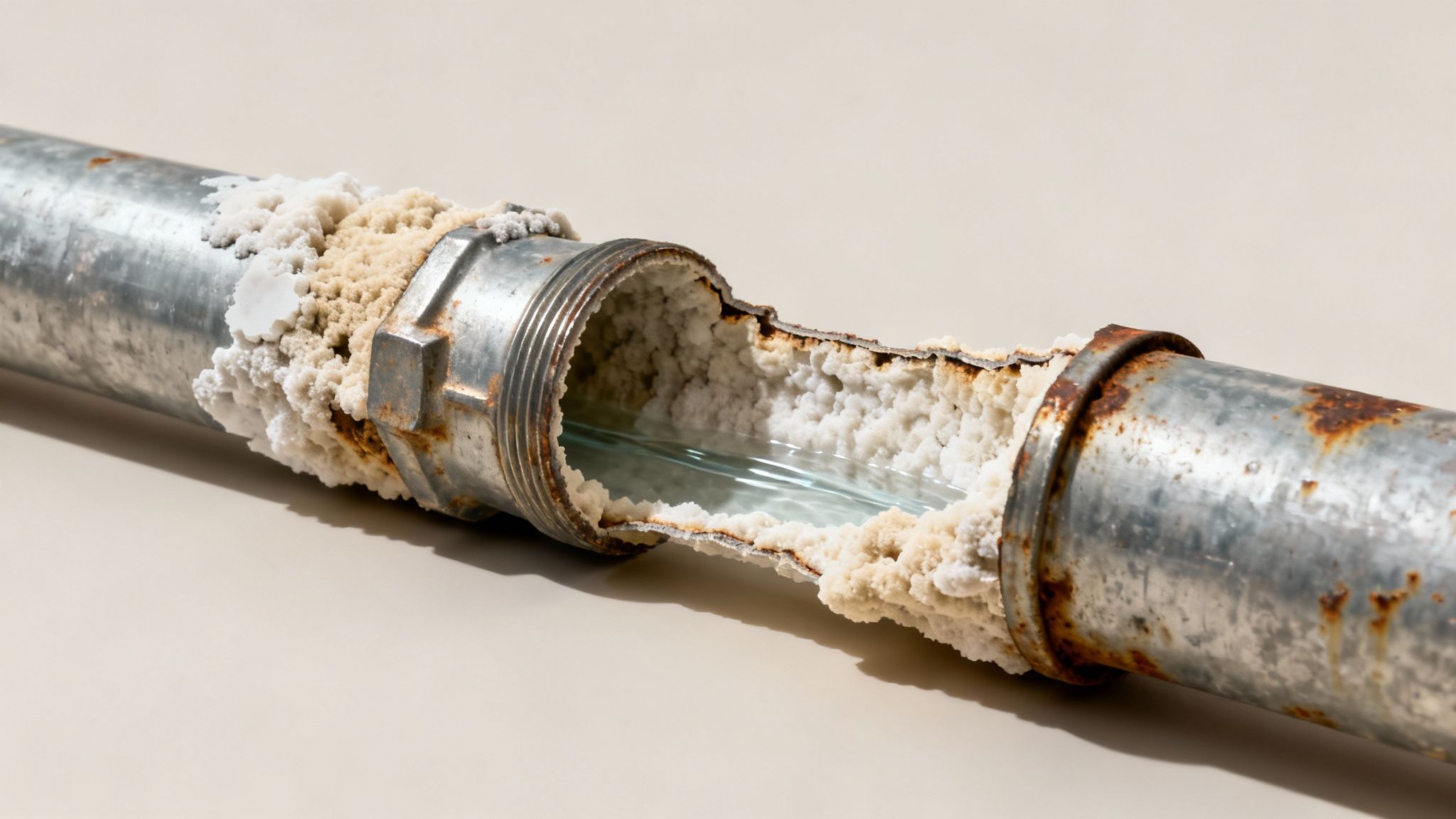
Think of your home's plumbing like a circulatory system. When pipes are new, water flows freely. But over years of use, various materials can accumulate, narrowing the passageway and restricting the flow.
The Problem With Our Hard Water Mineral Buildup
Residents of Southern California are well-acquainted with hard water, which is rich in dissolved minerals like calcium and magnesium. While safe to drink, these minerals can wreak havoc on your plumbing.
Over time, these minerals precipitate out of the water and form a hard, crusty deposit called limescale on the inner walls of your pipes. This scaling process gradually reduces the pipe's internal diameter. A pipe that was once an inch wide might effectively shrink to half that size after a decade, significantly reducing how much water can pass through.
This mineral accumulation is a leading cause of low water pressure in homes throughout Greater Los Angeles. We see it most often in older homes, particularly in neighborhoods like Pasadena or Hollywood, which often have original galvanized steel pipes that are prone to this type of buildup.
In hard water areas like ours, these deposits can reduce a pipe's inner diameter by as much as 50% in just 10 to 15 years.
When Rust and Debris Join the Party
It’s not just minerals. If your home has older galvanized steel or cast iron pipes, corrosion is another major factor. As these pipes age, they begin to rust from the inside.
This rust impacts your water pressure in two ways:
It creates a rough surface: The flaky texture of rust creates friction that slows down water as it passes through.
It creates blockages: Small pieces of rust flake off and are carried downstream, eventually lodging at bends or joints and forming larger clogs.
When limescale, rust, and other debris combine, they create a significant barrier. This buildup acts like a dam, and what causes low water pressure is this physical blockade preventing water from reaching your faucets and showerheads at full strength. To learn more about blockages, our guide on the common causes of recurring drain clogs offers helpful information.
How We Find and Fix Clogged Pipes
Not long ago, diagnosing a major pipe clog often involved guesswork and cutting into walls. Fortunately, modern technology has simplified this process.
Today, we can use a specialized sewer camera to get a live video feed from inside your pipes. We guide a flexible, high-resolution camera directly into your plumbing, allowing us to see the exact location and severity of any scale, corrosion, or blockages without damaging your walls.
Once we identify the problem, we have several effective solutions:
Hydro-Jetting: For stubborn clogs, we use a high-pressure water jet to scour the inside of the pipes, blasting away years of hardened scale and rust.
Targeted Pipe Repair: If the problem is confined to one area, a plumber might recommend replacing that specific section of pipe.
Whole-Home Repiping: For homes with widespread corrosion in old galvanized pipes, the best long-term solution is often to replace them entirely with modern copper or PEX pipes, which resist scaling and corrosion.
If you suspect that slowly clogging pipes are the cause of your weak water pressure, a professional diagnosis is the best first step. It provides a clear picture of the problem and a solid plan to restore your water flow.
If you've noticed your water pressure drops only when you turn on the hot water, you can likely rule out the main supply line. The real problem is probably hiding inside your water heater—a common yet often overlooked cause of pressure issues in Los Angeles homes.
This essential appliance works tirelessly, but over time, it can become a major bottleneck for your hot water, especially with Southern California's mineral-rich hard water.
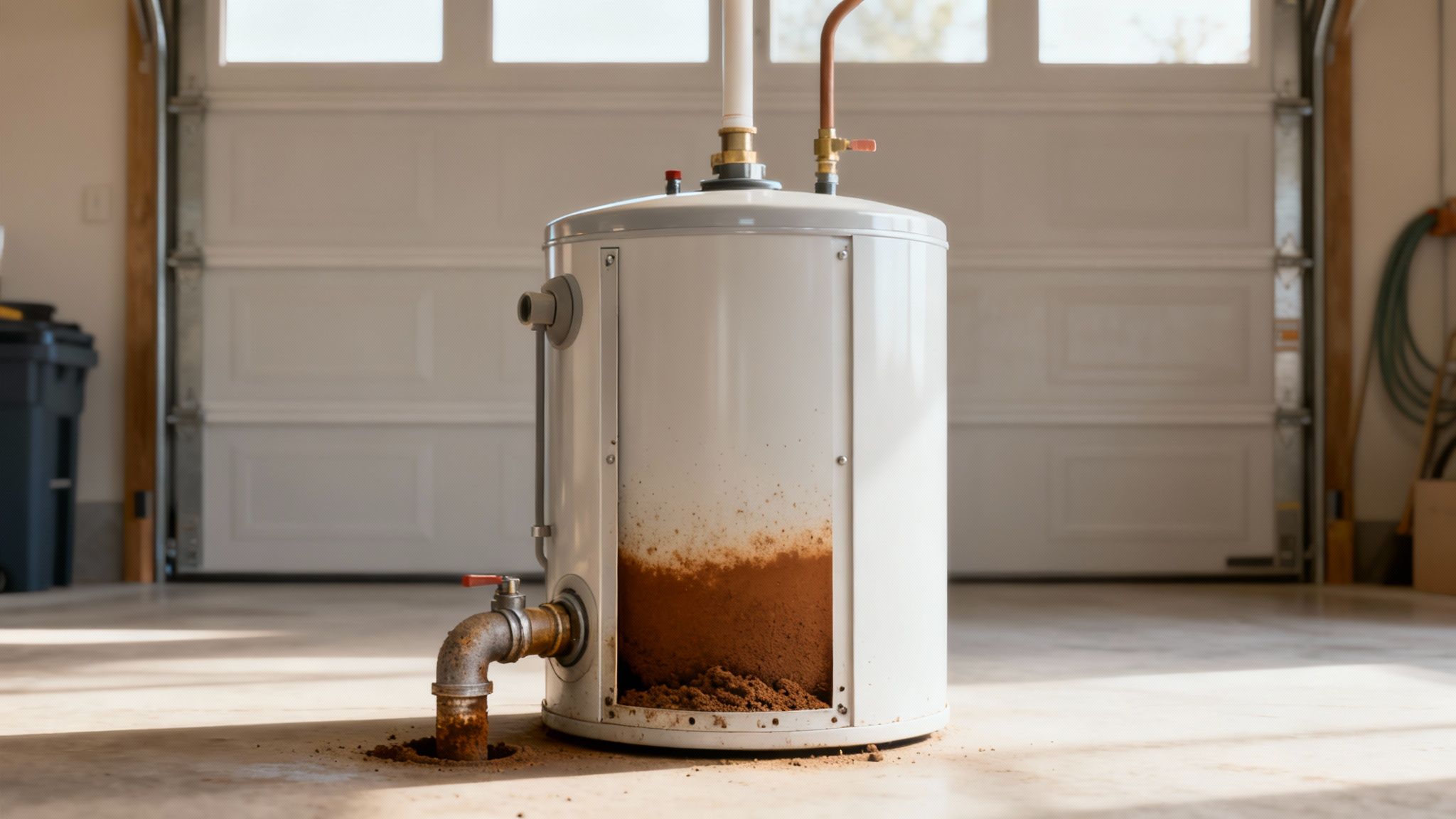
How Sediment Buildup Chokes Your Hot Water Flow
Imagine your tank-style water heater as a large kettle that's constantly heating water. As the water heats, minerals like calcium and magnesium separate and settle at the bottom, forming a thick layer of sediment.
This sludge creates a physical obstruction. The hot water outlet pipe is located near the top of the tank, but if sediment builds up high enough, it can start to block this opening, restricting hot water before it even leaves the tank.
The result is a frustrating drop in pressure that only affects your hot water. A sputtering faucet is a classic sign of this issue. In fact, faulty fixtures and water heaters are responsible for 25% of residential low-pressure complaints in the U.S.
Here in LA, where more than half the homes have tank-style heaters over 10 years old, heavy sediment can reduce output pressure by 40-60%. This can turn a healthy 2.5 gallons per minute (GPM) flow into a trickle of less than 1 GPM. You can learn more about how global water trends impact local infrastructure in this in-depth analysis from EcoWatch.
First, Check for Clogged Faucet Aerators
Before assuming your water heater is the problem, check for a simpler fix. Sometimes the issue isn't the heater itself but the faucet aerator or showerhead.
These small screens mix air into the water but are also perfect traps for sediment and scale from the tank. Over time, this debris can build up and create a mini-clog right at the fixture.
If your low hot water pressure is limited to a single sink or shower, a clogged aerator is the most likely culprit. This is a quick DIY fix that can often restore your flow immediately.
Here’s how to check and clean them:
Unscrew the Aerator: Gently twist off the tip of the faucet spout. Use a cloth to protect the finish if you need to use pliers.
Inspect the Screen: Turn it upside down and tap it into your palm to dislodge any gritty deposits or flakes.
Soak and Scrub: Soak the parts in a bowl of white vinegar for about an hour to dissolve mineral buildup.
Rinse and Reassemble: Use an old toothbrush to scrub away any remaining debris, rinse the parts thoroughly, and screw the aerator back on.
For showerheads, you can either unscrew the head and soak it or fill a plastic bag with vinegar and tie it around the showerhead to soak overnight.
When to Bring in a Professional
If cleaning the aerators doesn't solve the problem, or if every hot water tap in your home has low pressure, the sediment in your water heater is likely too severe for a DIY fix. While regular flushing can help maintain a heater, significant buildup requires professional service.
For more tips, take a look at our homeowner’s guide to water heater troubleshooting.
For many LA homeowners, this is an ideal time to consider an upgrade. Modern tankless water heaters eliminate this problem by heating water on demand, preventing sediment from accumulating in a storage tank.
Identifying Hidden Leaks And Faulty Regulators
Sometimes, low water pressure is caused by a silent problem working behind the scenes. Two of the most common and serious offenders are a failing pressure regulator and a hidden water leak.
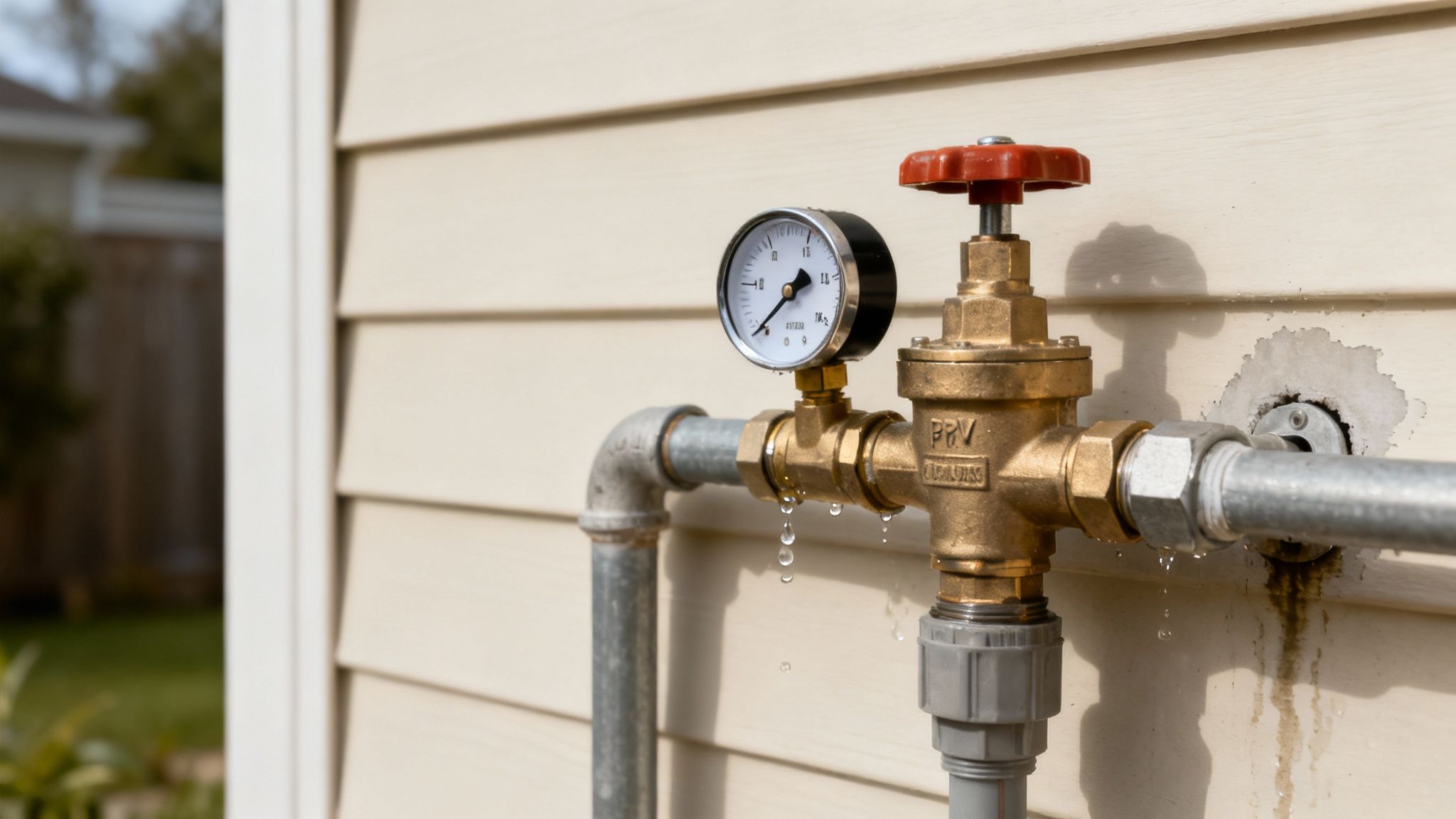
These issues are more severe than a simple clog because they affect every fixture in your home and can lead to significant damage if left unaddressed. Early detection is key to protecting your property and restoring normal water flow.
Is Your Pressure Regulator Failing?
Your home's Pressure Reducing Valve (PRV), or pressure regulator, acts as a gatekeeper for your plumbing system. Water from the city, like that from LADWP, often enters at very high pressure, sometimes exceeding 150 PSI. The PRV's job is to reduce this pressure to a safe and steady level, typically between 40 and 60 PSI.
Like any mechanical part, PRVs wear out over time. After 10-15 years, their internal components can corrode, wear down, or become clogged with sediment.
When a PRV fails, it can get stuck partially closed, creating a bottleneck that causes a consistent drop in pressure at every tap. Other signs of a failing regulator include:
Loud banging or vibrating sounds (water hammer) when you turn off faucets.
Water pressure that fluctuates randomly.
A sudden increase in pressure, which poses a serious risk to your plumbing.
A failing pressure regulator is not a DIY project. It requires working directly with the main water line and should be diagnosed and replaced by a licensed plumber to ensure your home is protected from both low and dangerously high pressure.
The Silent Threat of a Hidden Leak
While a faulty regulator restricts your water supply, a hidden leak actively steals it. Even a small pinhole leak in a pipe behind a wall, under your concrete slab, or in a crawlspace can cause a significant, system-wide drop in water pressure.
These leaks are particularly dangerous because they often go unnoticed for weeks or months, silently causing rot, mold, and structural damage. Besides low pressure, a major red flag is an unexplained spike in your water bill.
Knowing the critical things to look for when inspecting a home can be a huge help. If you suspect a hidden leak, act quickly. Our guide on the signs you might have a hidden leak in your home can help you spot the warning signs.
Fortunately, modern plumbers use non-invasive technology to find these leaks without tearing your house apart. Using tools like acoustic sensors and thermal imaging cameras, a professional can pinpoint the exact location of the problem for a precise and minimally disruptive repair.
When You Need To Call A Professional Plumber
While cleaning a showerhead or checking a shut-off valve are excellent first steps, many causes of low water pressure are not DIY-friendly. Attempting to fix complex plumbing issues without the right tools and training can quickly turn a small problem into a costly disaster.
Knowing when to call a professional is crucial for protecting your home.
Certain situations are too risky to handle on your own. These are critical moments where the expertise of a licensed plumber is necessary to prevent significant water damage.
Non-Negotiable Scenarios For A Pro
Some plumbing problems are too complex or dangerous for a homeowner to address. If you suspect any of the following issues, your first move should be to call a professional.
You Suspect a Slab Leak: Do you notice warm spots on your floor or hear water running when all taps are off? These are classic signs of a leak beneath your home's concrete slab. This requires specialized electronic leak detection equipment to locate the problem without destroying your floors.
The Problem is Your Main Water Line: Any issue with the main line connecting your home to the city’s supply is a serious matter. Repairs often involve excavation and must be handled by licensed plumbers familiar with local codes from Santa Monica to Glendale.
Your Pressure Regulator is Failing: A faulty Pressure Regulating Valve (PRV) can cause not only low pressure but also loud banging noises in your pipes. Replacing this valve involves shutting off water to the entire house and working with high-pressure lines—a job for an experienced technician.
Repiping an Older Home: If low pressure is due to corrosion in old galvanized pipes, the only permanent solution is to repipe the house. This major project requires professional planning and execution to ensure your new system is safe, reliable, and up to code.
Attempting to fix these issues yourself can lead to bigger leaks, structural damage, and violations of local building codes. A professional diagnosis provides a reliable fix and peace of mind.
Ultimately, a persistent, house-wide drop in pressure is a clear signal that it's time for an expert diagnosis. A licensed plumber has the tools and experience to accurately pinpoint the source of your low water pressure and offer a permanent solution.
If you're unsure what to do next, our guide on how to choose the right plumbing professional for your home can help. For homeowners across Los Angeles, a professional opinion is the fastest and safest way to restore your water flow and protect your property.
Still Have Questions About Low Water Pressure?
Even after checking the usual suspects, it's normal to have questions about why your Los Angeles home's water pressure has dropped. Getting clear answers can help you decide what to do next. Here are some of the most common questions we hear from homeowners.
How Can I Test My Home's Water Pressure Myself?
You don't need to be a plumber to check your home's water pressure. You can perform a simple test with an inexpensive tool from any hardware store.
All you need is a water pressure gauge, which screws onto an outdoor hose bib. To get an accurate reading:
Ensure all faucets, showers, and water-using appliances in your home are turned off.
Screw the gauge tightly onto the hose bib.
Turn the faucet handle all the way on.
The needle on the gauge will indicate the static water pressure in pounds per square inch (PSI).
For most homes in the LA area, a healthy reading is between 40 and 60 PSI. If your gauge shows a number significantly below that, it confirms a low-pressure problem. A reading above 80 PSI is dangerously high and suggests a faulty pressure regulator.
Can A New Appliance Cause Low Water Pressure?
It's a common scenario: you install a new refrigerator or dishwasher, and suddenly the water pressure throughout your house seems lower. However, a single new appliance is almost never the cause of a house-wide pressure drop.
If you only notice weak flow at the new appliance, the issue is likely isolated to it—perhaps a supply valve that isn't fully open or a kink in the water line. But if every faucet in your home is affected, the timing is probably a coincidence. The real culprit is likely a larger issue, like a failing pressure regulator, that happened to become noticeable at the same time.
Why Is My Water Pressure Low Only In The Shower?
If your kitchen sink has strong pressure but your shower is a weak trickle, the problem is isolated to that fixture. This is usually good news, as it often means an easy fix.
The most common cause of a weak shower is a clogged showerhead. Over time, mineral deposits from LA's hard water can build up and block the spray nozzles.
Often, all you need to do is unscrew the showerhead and soak it in a bowl of white vinegar overnight. This will usually dissolve the buildup and restore normal flow. If that doesn't work, the issue might be a clogged flow restrictor inside the fixture or a failing shower valve, which may require professional attention.
Does The City Ever Lower Water Pressure On Purpose?
Yes, sometimes the city is the source of the problem. The Los Angeles Department of Water and Power (LADWP) may reduce pressure in an area for several reasons, such as scheduled maintenance, repairing a water main break, or conserving water during a drought.
These pressure drops are typically temporary and will affect your entire neighborhood, not just your house. The easiest way to confirm is to ask a neighbor if they are experiencing the same issue. You can also check the LADWP website for any service alerts in your area.
If you've tried these DIY fixes and are still dealing with frustratingly weak water flow, it's time to call in the experts. For a clear diagnosis and a lasting solution, you can trust the licensed professionals at ZH Plumbing. Contact us today for a comprehensive plumbing inspection.
Comments